
Anker SOLIX F3000 vs EcoFlow DELTA Pro 3: Home Backup Bet
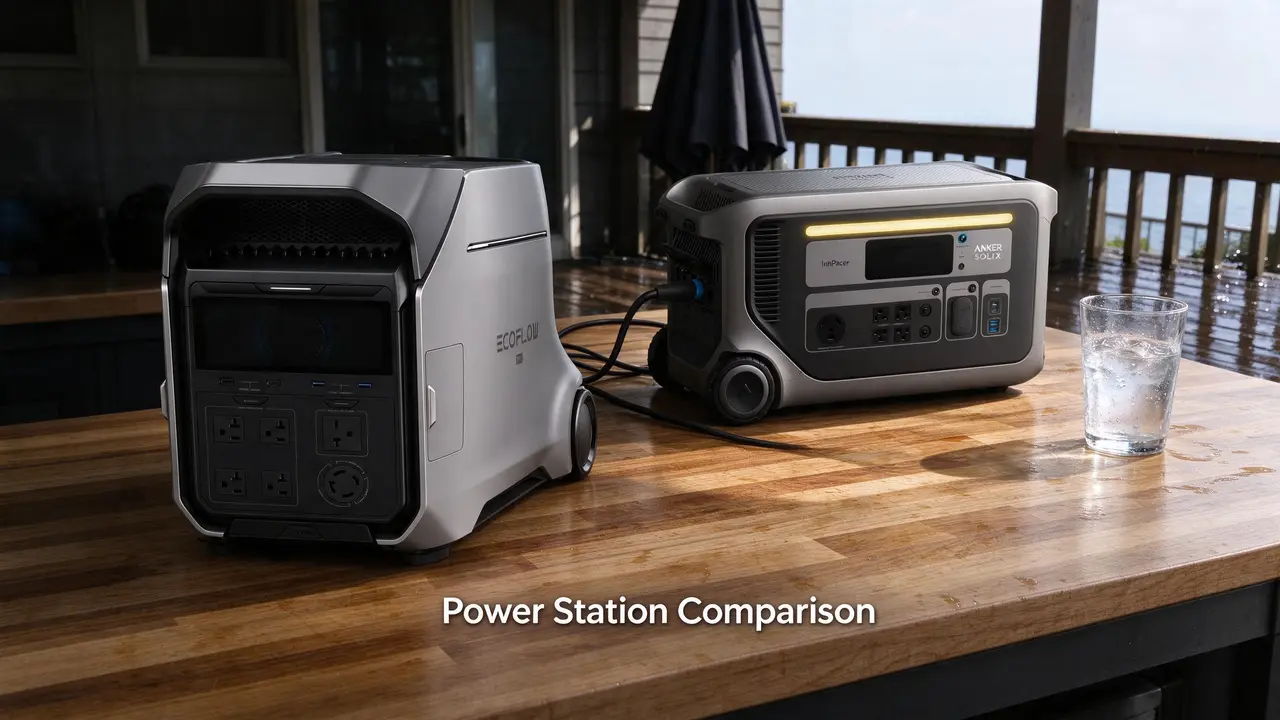
Two near-$3,200 whole-home bets, and they don't buy the same thing. The EcoFlow DELTA Pro 3 gives you 4,096 Wh and 4,000 W in one box; the Anker SOLIX F3000 listing promises 6,000 W fast recharge and 24 kWh expansion. Here's which one fits your outage plan.
Updated
At a glance
Two near-$3,200 whole-home bets, and they don't buy the same thing. The EcoFlow DELTA Pro 3 gives you 4,096 Wh and 4,000 W in one box; the Anker SOLIX F3000 listing promises 6,000 W fast recharge and 24 kWh expansion. Here's which one fits your outage plan.
Same money, different bets
As an Amazon Associate I earn from qualifying purchases. Recommendations here are based on fit and the evidence below — not commission size.
At list price these two sit about $500 apart — $3,699 for the EcoFlow DELTA Pro 3 and $3,198.99 for the Anker SOLIX F3000 — which is close enough that the decision comes down to what each one is actually built to do, not the sticker. Prices and ratings are as of the listings reviewed for this comparison.
The DELTA Pro 3 bets on one big box: 4,096 Wh of LFP, 4,000 W continuous AC, and a 240V split-phase outlet you can wire to a transfer switch or smart panel without buying a second unit. The Anker SOLIX F3000 bets on recharge speed and expansion headroom — the listing claims 6,000 W combined generator-plus-solar input and expansion to 24 kWh, but it reaches 240V by pairing two stations, not one.
That's the fork. If you want a single unit that can back up a well pump or a central AC on its own, the EcoFlow is the cleaner bet. If your outage plan is generator-assisted and you expect to grow capacity over years, the Anker's recharge and expansion story is the one to price out.
If you can't wait for a clean Anker capacity spec, the default is the EcoFlow DELTA Pro 3 — it's the only one of the two you can cost out per Wh today.
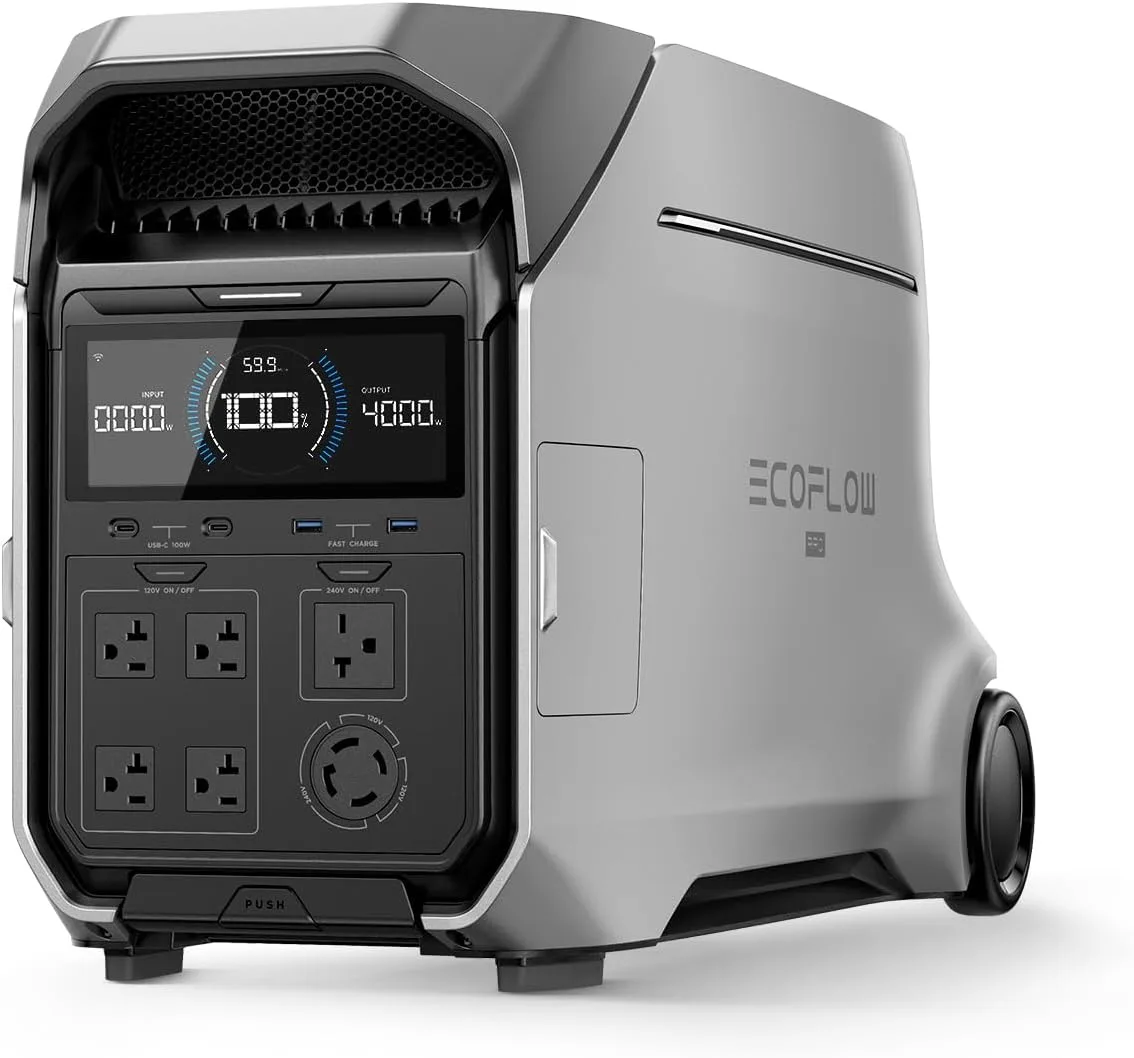
EcoFlow DELTA Pro 3 Portable Power Station, 4096Wh
Highlights
- 4096Wh rated capacity
- 4000W continuous AC
- 8000W surge
- LiFePO4 chemistry
- Up to 2600W solar input
- 113.5 lb (~51.5 kg)
Best for
- DELTA Pro 3: longer outages or higher continuous loads (still not whole-home wiring)
- RV / off-grid days where recharge speed matters as much as Wh
- Best parked near the vehicle or cabin — not a long carry to a tent
Strengths
- DELTA Pro 3: 4096Wh pack with 4000W continuous / 8000W surge — size loads to both numbers
- 113.5 lb (~51.5 kg) is a park-and-use chassis — plan a short path, not a trail hike
- 10ms-class UPS switchover on the listing — useful when a router restart would hurt
- About $3699 list in the Hub catalog — confirm live retail before you buy
Watch-outs · not ideal when
- At 113.5 lb (~51.5 kg), DELTA Pro 3 is a poor tent-hike companion — plan a cart or leave it in the vehicle
- High continuous output on DELTA Pro 3 tempts big loads — Wh still runs out on kettles and A/C
- Rated 2600W solar on DELTA Pro 3 is optimistic; shade and cables cut real watts
- LiFePO4 helps longevity, but DELTA Pro 3 still hates freezing charge temps on winter trips
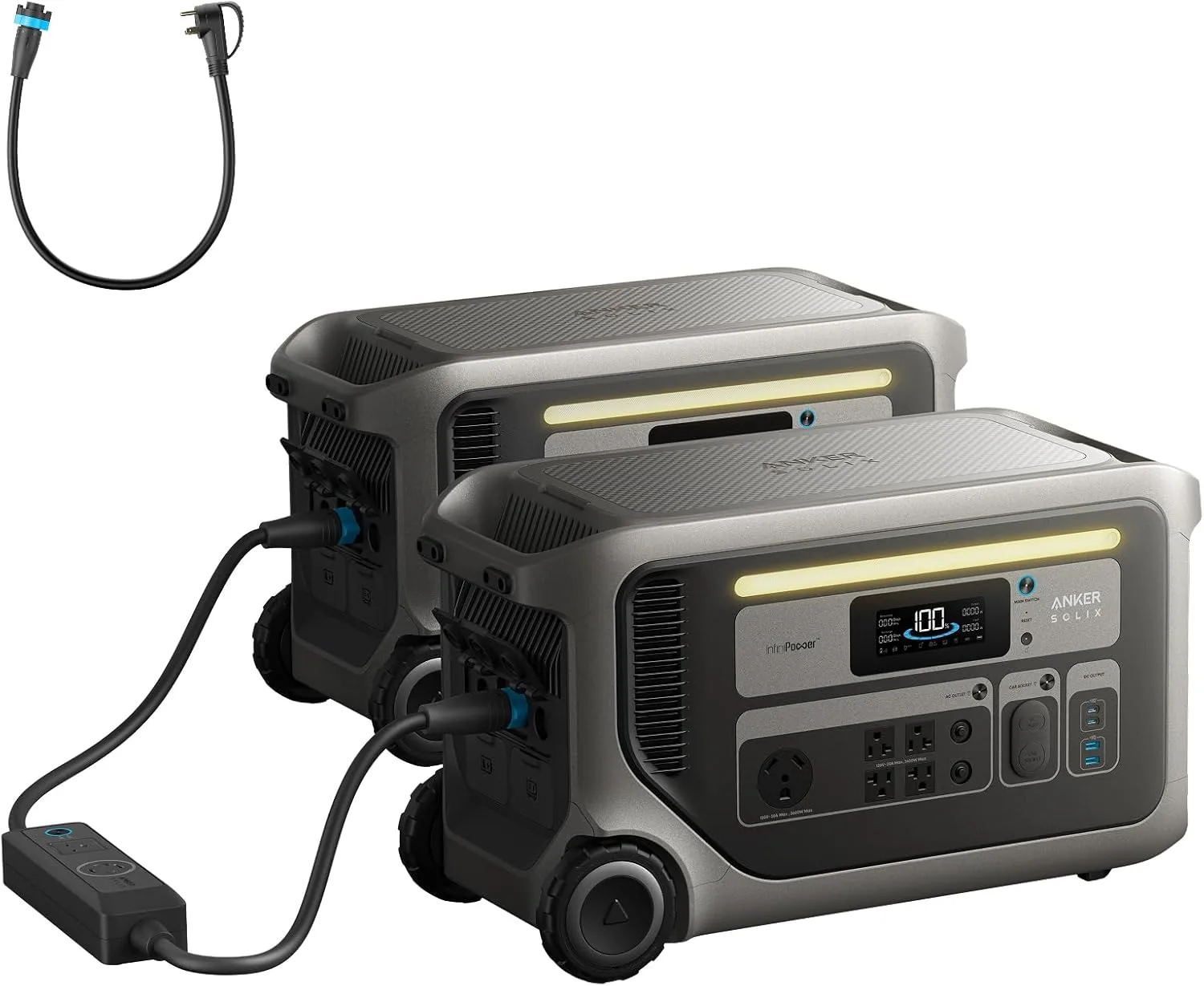
Anker 3,072Wh LiFePO4 Battery, Expandable to 24kWh, 6,000W Fast Recharging, Solar
Highlights
- 72Wh rated capacity
- 3600W continuous AC
- LiFePO4 chemistry
- 91.5 lb (~41.5 kg)
- About $3198.99 list
Best for
- SOLIX F3002: phones, cameras and a laptop on short trips
- Travel kits when you need quiet pack power, not appliance runtime
- Brief desk backup for router and lights — not a fridge for days
Strengths
- SOLIX F3002: 3600W continuous on a 72Wh pack — more headroom for small appliances than 1kW-class peers
- 91.5 lb (~41.5 kg) is a park-and-use chassis — plan a short path, not a trail hike
- 3600W continuous headroom covers more small appliances than 1kW-class inverters
- About $3198.99 list in the Hub catalog — confirm live retail before you buy
Watch-outs · not ideal when
- At 91.5 lb (~41.5 kg), SOLIX F3002 is a poor tent-hike companion — plan a cart or leave it in the vehicle
- Usable energy on SOLIX F3002 is below the 72Wh label once the inverter is working
- Solar input unpublished for SOLIX F3002 — do not assume a same-day off-grid refill
- Airline and pack limits may still block SOLIX F3002 even when the weight looks friendly
Spec snapshot
Numbers below are from the listings and the WattPicks catalogue, not from a bench. Where a figure isn't published, it's marked n/a (not on file) rather than guessed. The Anker capacity cell is n/a because the listing shows 72 Wh against a 3,072 Wh model name — a listing data error, not a usable spec. The Anker rating is a listing rating, not an owner sample.
| Product | Price | Capacity (Wh) | Output (W) | 240V path | Expansion ceiling | Weight (lb) | Rating |
|---|---|---|---|---|---|---|---|
| EcoFlow DELTA Pro 3 Portable Power Station, 4096Wh | $3699 | 4096 Wh | 4000 W | Native 240V outlet | 48 kWh (listed) | 113.5 lb | 4.3 |
| Anker 3,072Wh LiFePO4 Battery, Expandable to 24kWh, 6,000W Fast | $3198.99 | n/a (listing error) | 3600 W | Two units + Double Voltage Hub | 24 kWh (listed) | 91.5 lb | 5 (listing rating, not owner sample) |
Where the money went
Four configuration differences do most of the work here. The first is capacity in a single unit: 4,096 Wh on the EcoFlow versus a listing figure of 72 Wh on the Anker — that Anker number is almost certainly a listing data error against a 3,072 Wh model name, so treat it as n/a (not on file) until Anker publishes a clean spec. Don't plan an outage around 72 Wh.
The second is how each reaches 240V. The DELTA Pro 3 has a native 240V output and the listing says it can run a 3-ton central AC or a 1 HP water pump on its own. The Anker listing is explicit that 240V comes from pairing two power stations through its Double Voltage Hub — which is included, but means a second $3,198.99 unit before you get there.
Third, recharge. EcoFlow lists 1,800 W AC input and up to 7,000 W combined AC + solar + Smart Generator; Anker claims 6,000 W combined fuel-generator-plus-solar and 2,400 W solar. Both are fast on paper. The Anker's edge is the higher solar ceiling if you're building a panel array; the EcoFlow's edge is that owners report a couple of hours from a gas generator is enough to carry a house the rest of the day.
Fourth, expansion. EcoFlow lists expansion to 48 kWh with extra batteries and smart generators, and owners describe stacking a 4,096 Wh extra battery on top cleanly — though it immobilizes the main unit. Anker lists expansion to 24 kWh. On paper the EcoFlow ceiling is higher; in practice both get expensive fast, and neither is a cheap path to whole-home storage.
- Single-unit 240V: EcoFlow yes, Anker needs a second station plus the included Double Voltage Hub.
- Solar ceiling: Anker lists 2,400 W; EcoFlow lists 1,600 W + 1,000 W dual inputs.
- Expansion ceiling: EcoFlow lists 48 kWh; Anker lists 24 kWh.
- Weight: Anker 91.5 lb vs EcoFlow 113.5 lb — both are two-person lifts.
The spec that decides it
For most buyers the deciding number is continuous AC output in a single box. The DELTA Pro 3's 4,000 W covers a fridge, a well pump, lights, and a window AC at the same time; owners describe running a 240V well pump off it during a real outage. The Anker's 3,600 W is close, but its 240V path requires a second unit, so the practical single-box ceiling is lower.
The second deciding number is price per nameplate Wh. At list, the EcoFlow works out to about $0.90/Wh. The Anker cannot be compared until it publishes a clean capacity spec — the 72 Wh listing figure would imply an absurd $44.43/Wh, which is exactly why it's flagged as a data error rather than used as a comparison. That's not a knock on the hardware; it's a knock on the data.
How we scored them
We weighted five things a whole-home backup buyer actually lives with, then scored each unit High/Med/Low on the evidence on file. Weights reflect what breaks an outage plan first.
Capacity in one box — weight 30%. Why: it decides whether you can run a well pump or central AC without buying a second unit. EcoFlow High (4,096 Wh, 4,000 W); Anker Med (3,600 W, capacity n/a).
240V path — weight 25%. Why: most whole-home loads are 240V, and a second-unit requirement doubles the entry price. EcoFlow High (native outlet); Anker Low (needs a second station plus hub).
Recharge — weight 20%. Why: outage days are recharge days. EcoFlow High (1,800 W AC, 7,000 W combined); Anker High on paper (6,000 W combined, 2,400 W solar) but listing-only.
Expansion — weight 15%. Why: it's how you grow into whole-home storage over years. EcoFlow High (48 kWh listed); Anker Med (24 kWh listed).
Weight and portability — weight 10%. Why: both are two-person lifts, so this rarely flips the call. EcoFlow Med (113.5 lb); Anker Med (91.5 lb).
Tracing the #1 vs #2 call: the EcoFlow wins on the two heaviest weights — single-box capacity and a native 240V path — and those are the two that decide whether the unit works on day one of an outage. The Anker only leads on recharge ceiling and lighter weight, and its capacity is still n/a. That's why the EcoFlow takes #1 despite the higher sticker.
- EcoFlow owners: strong on whole-home capability and UPS switchover; critical of weight, app, and warranty logistics.
- Anker owners: no meaningful sample yet — treat listing claims as unverified.
Real owner trade-offs
EcoFlow DELTA Pro 3 feedback is thick and mostly positive on capability, with a consistent set of gripes. Owners report the UPS pass-through kept a desktop running through a simulated blackout without a reboot, and that a gas generator plus the DP3 carried a house — including a 240V well pump — through a one-day outage. The recurring complaints: it's heavy and awkward over thresholds, the app is confusing and settings conflict, and one high-helpful owner spent weeks fighting hazardous-material shipping rules to return a failed unit. That last one is the risk to weigh before you buy any 100+ lb battery. These owner reports are paraphrased from owner notes and listing reviews, not independently verified.
Anker SOLIX F3000 has essentially no owner feedback on file — the listing shows a single rating (listing rating, not owner sample), which is not enough to call a pattern. I would not invent friction or praise here. The listing claims are plausible for the class (6,000 W combined recharge, 24 kWh expansion, 3,600 W pass-through), but they are listing claims until owners accumulate.
- EcoFlow owners praise whole-home capability and UPS switchover, but flag weight, app confusion, and warranty logistics.
- Anker buyers have no meaningful owner sample yet — treat listing claims as unverified.
What could go wrong with the Anker
The EcoFlow gripes are well documented; the Anker's risks are mostly unknowns, and unknowns deserve their own list before you spend $3,198.99.
Warranty terms: the listing doesn't spell out a clear warranty length or what's covered on the expansion batteries, so confirm that in writing before you buy.
Return logistics: at 91.5 lb this is a freight-class return, and the EcoFlow owner story above shows how painful hazardous-material shipping rules can be. Ask the seller who pays return freight and how a failed unit gets picked up.
App and ecosystem: there's no owner sample on the Anker app, so you can't yet know how its monitoring, firmware updates, or smart-panel integration behave in practice. Treat the app as unproven until reviews accumulate.
Capacity spec: the 72 Wh listing figure is a data error, and until Anker publishes a clean number you're buying on the model name (3,072 Wh) rather than a verified spec.
Buy the one that…
Buy the EcoFlow DELTA Pro 3 if you want one box that can carry a 240V load — a well pump, a central AC, a transfer-switch feed — without buying a second station, and you're willing to park it in a garage or basement and rarely move it. The 4,096 Wh / 4,000 W combination and the owner-reported generator-recharge workflow are the reasons.
Buy the Anker SOLIX F3000 if your plan is generator-assisted and you expect to grow capacity over years — the 6,000 W combined recharge and 24 kWh expansion path are the pitch — and you're comfortable being an early owner while the capacity spec and owner feedback fill in. Skip both if you need something you'll haul to a campsite; at 91.5 lb and 113.5 lb, neither is a portable in any practical sense.
- If you already own an EcoFlow battery, the expansion path changes the math — stacking onto the DELTA Pro 3 is cheaper than starting over with an Anker pair.
- If you only care about solar recharge ceiling, pick the Anker on paper (2,400 W listed) — but wait for a clean capacity spec.
- If you're renting or in a condo, pick neither as a permanent install: both need a transfer switch or smart panel you may not be allowed to add. A smaller single-unit setup is the better fit.
- Transfer switch vs smart panel: a manual transfer switch is the lower-cost path if you only need a few circuits; a smart panel costs more but gives circuit-level control and app monitoring. Budget for the panel either way — neither unit includes it.
Frequently asked
Can the Anker SOLIX F3000 run a 240V well pump on its own?
Per the listing, no — 240V requires pairing two stations through the included Double Voltage Hub. The EcoFlow DELTA Pro 3 lists native 240V output and owners report running a 240V well pump off a single unit.
How long will either run a fridge?
The Anker listing claims 42 hours on a 190 W fridge load; the EcoFlow listing doesn't publish a fridge runtime, and owners describe multi-day outage coverage without giving a single-load figure. Treat both as listing claims, not measured runtimes.
Which is cheaper per Wh?
On nameplate figures, the EcoFlow at about $0.90/Wh is the only one of the two that can be costed honestly — the Anker's 72 Wh listing figure is a data error against a 3,072 Wh model name, so the comparison cannot be made until Anker publishes capacity. Wait for a clean spec.
Do I need a transfer switch or smart panel?
For whole-home backup, yes — both units are designed to feed a transfer switch or smart panel (EcoFlow lists Smart Home Panel 2 compatibility; Anker lists a Bi-Directional Inlet Box and Smart Meter). Neither includes the panel.
Method and sources
Model names and list prices come from the WattPicks catalog at build time. WattPicks does not run its own laboratory tests on power stations, and nothing on this page is presented as a measured result — it is catalog-backed buying guidance.
Read our methodology for how the catalog is normalized, and about WattPicks for who publishes it.