
LiFePO4 Power Station Showdown: ALLWEI PPS600-1 vs Anker C300
Both are LiFePO4, so the real fight is capacity vs. portability. We compare the ALLWEI PPS600-1 and Anker C300 on cost per Wh, weight, and owner-reported quirks.
Updated
At a glance
Both are LiFePO4, so the real fight is capacity vs. portability. We compare the ALLWEI PPS600-1 and Anker C300 on cost per Wh, weight, and owner-reported quirks.
- ALLWEI PPS600-1: 512 Wh, 500 W, 13 lb, $279 — more capacity per dollar.
- Anker C300: 288 Wh, 300 W, 9.1 lb, $329.99 — lighter, more ports, faster charging on paper.
Two LiFePO4 stations, one clear trade-off
You need a small power station for camping, a CPAP, or a short outage. The two units here both use LiFePO4 chemistry, so the decision is not about battery type — it is about capacity versus portability. The ALLWEI PPS600-1 gives you 512 Wh and 500 W for $279. The Anker C300 gives you 288 Wh and 300 W for $329.99. That is a $50.99 premium for less capacity and lower output, so the Anker has to win on something other than raw numbers.
On paper, the ALLWEI is the capacity play and the Anker is the portability play. The rest of this comparison is about which trade-off fits your actual use.
- ALLWEI PPS600-1: 512 Wh, 500 W, 13 lb, $279 — more capacity per dollar.
- Anker C300: 288 Wh, 300 W, 9.1 lb, $329.99 — lighter, more ports, faster charging on paper.
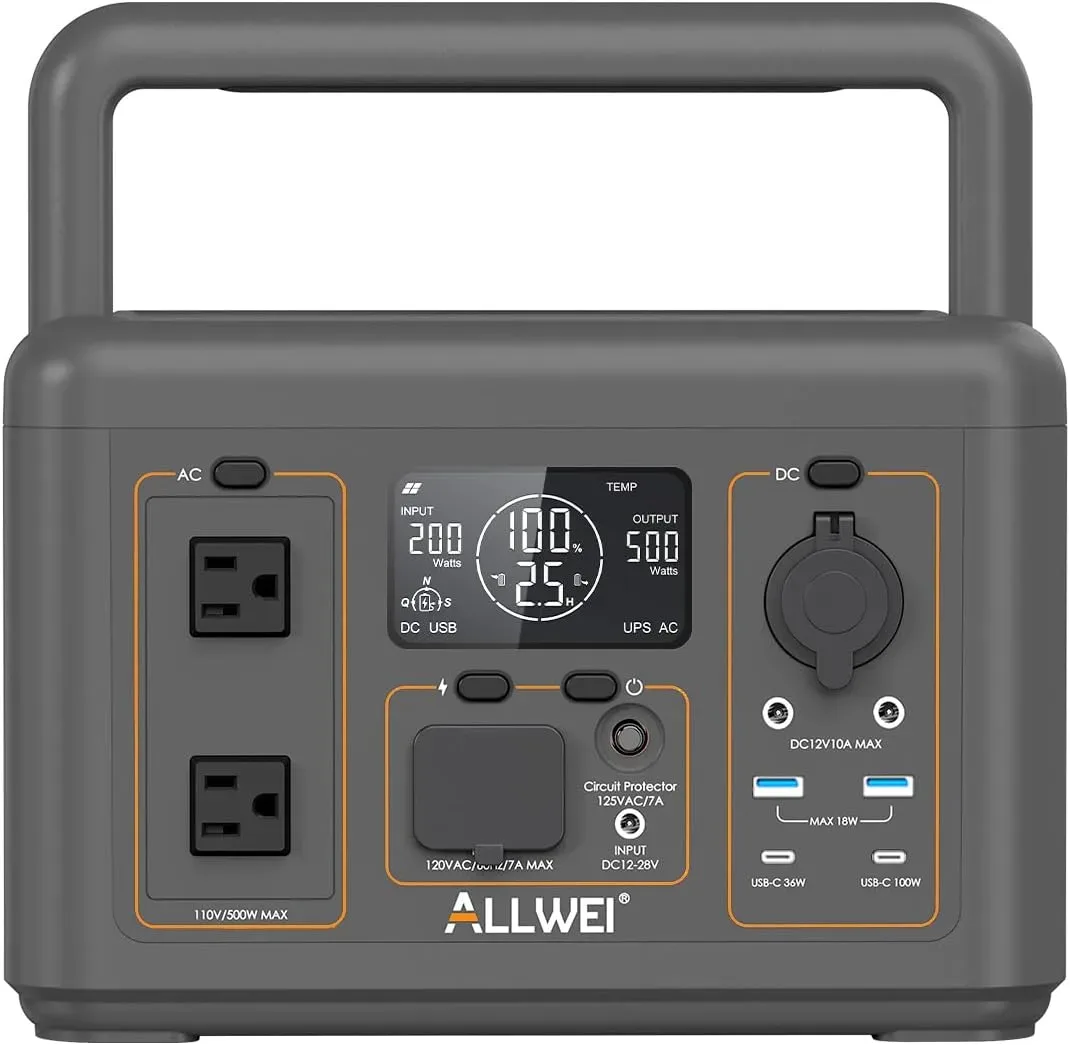
ALLWEI Portable Power Station 500W, 512Wh LiFePO4 Battery UPS Backup Power
Highlights
- 512Wh rated capacity
- 500W continuous AC
- LiFePO4 chemistry
- 13 lb (~5.9 kg)
- About $279 list
Best for
- Portable: weekend camping when 13 lb carry weight matters as much as 512Wh
- Essentials bridge at home (fridge cycles, router) when sized to the Wh
- Car or wall recharge between camps when solar input is accessory-dependent
Strengths
- Portable: 512Wh / 500W continuous — treat as electronics and light loads, not a tool inverter
- 13 lb (~5.9 kg) is the lightest-class carry in this band — easier stairs and car packing
- Portable uses LiFePO4 — cycle-life claims usually beat older NMC marketing lines
- About $279 list in the Hub catalog — confirm live retail before you buy
Watch-outs · not ideal when
- Portable is still a bridge for essentials — not a transfer-switch whole-home system
- 500W continuous will not hold heating elements or many compressor surges for long
- Solar input unpublished for Portable — do not assume a same-day off-grid refill
- LiFePO4 helps longevity, but Portable still hates freezing charge temps on winter trips
Owner voices
Short takes from public retail reviews — paraphrased or translated when long or non-English; meaning kept close to the original.
“Theme: Phone Charging (74)”
“Theme: Mini Appliances (24)”
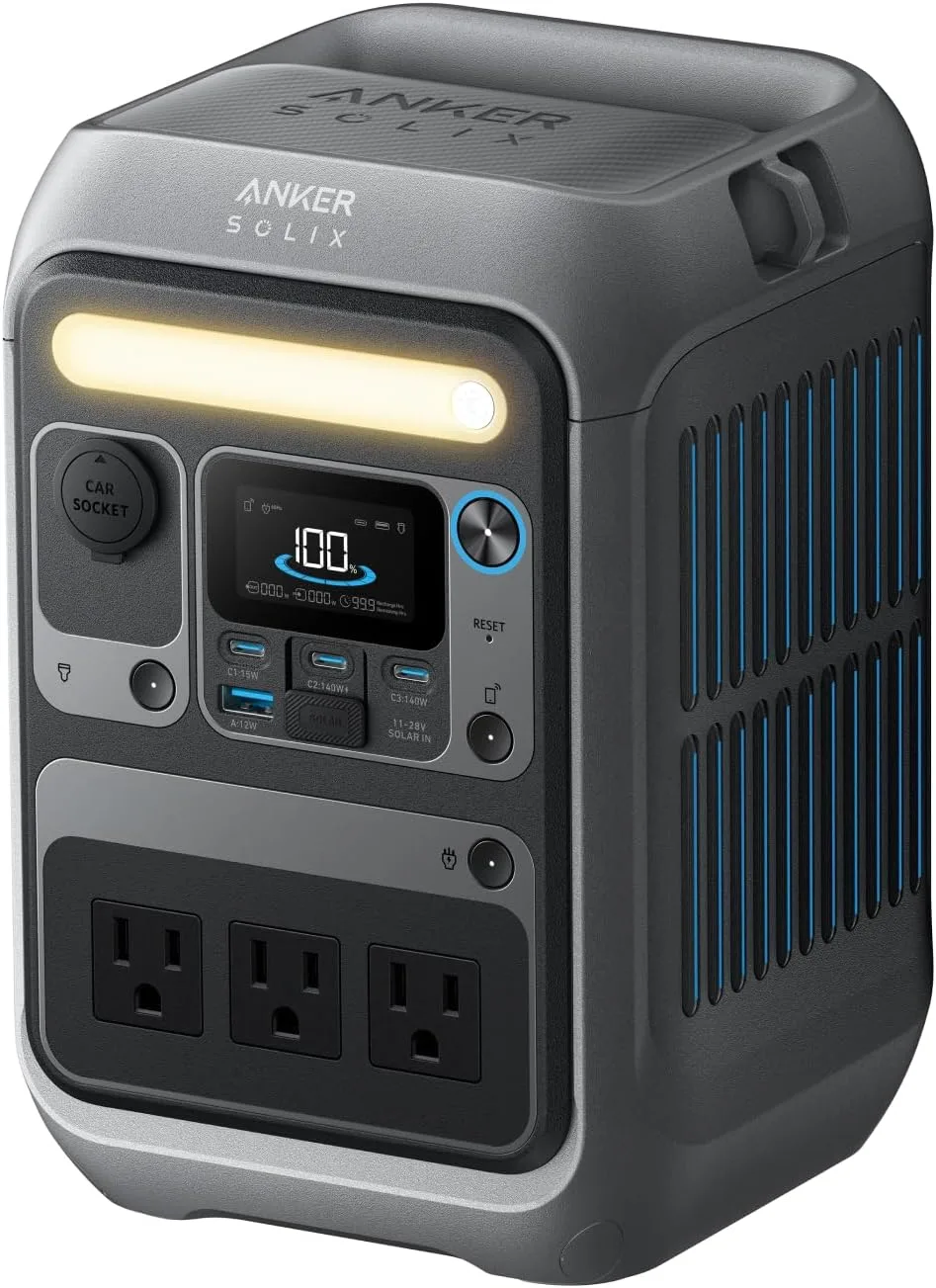
Anker C300 Portable Power Station, 288Wh Solar Generator
Highlights
- 288Wh rated capacity
- 300W continuous AC
- 600W surge
- LiFePO4 chemistry
- 9.1 lb (~4.1 kg)
- About $329.99 list
Best for
- SOLIX C300: phones, cameras and a laptop on short trips
- Travel kits when you need quiet pack power, not appliance runtime
- Brief desk backup for router and lights — not a fridge for days
Strengths
- SOLIX C300: 288Wh pack with 300W continuous / 600W surge — size loads to both numbers
- 9.1 lb (~4.1 kg) is the lightest-class carry in this band — easier stairs and car packing
- SOLIX C300 uses LiFePO4 — cycle-life claims usually beat older NMC marketing lines
- Owners on file: Theme: Customers find the power station performs well as an uninterruptible power supply and appreciate its f…
Watch-outs · not ideal when
- SOLIX C300's small Wh class empties fast with a kettle, hair dryer or space heater
- 300W continuous will not hold heating elements or many compressor surges for long
- Solar input unpublished for SOLIX C300 — do not assume a same-day off-grid refill
- Airline and pack limits may still block SOLIX C300 even when the weight looks friendly
Owner voices
Short takes from public retail reviews — paraphrased or translated when long or non-English; meaning kept close to the original.
“Theme: Customers find the power station performs well as an uninterruptible power supply and appreciate its fast charging capability, reaching 80% in about 50-55 minutes. They praise its power delivery, with one custo…”
“Theme: Charging Devices (64)”
“Theme: Outdoor Electronics (25)”
Methodology
I am a deep-use experience reviewer working from listing specs and owner themes on file, not lab-bench measurements. For this comparison I weighted capacity per dollar (40%), continuous output (25%), weight and portability (20%), and owner-reported reliability themes (15%). The ALLWEI wins on the first two; the Anker wins on weight and portability. Owner themes are mixed but lean positive for both. Prices are list prices from the product data, not sale prices. As an Amazon Associate, WattPicks earns from qualifying purchases; picks are fit-led, not commission-led.
Here is the weighted scoreboard applied to the listing facts. Scores are 1–5 on each criterion, weighted by the percentages above.
| Criterion (weight) | ALLWEI PPS600-1 | Anker C300 |
|---|---|---|
| Capacity per dollar (40%) | 5 — $0.54/Wh | 2 — $1.15/Wh |
| Continuous output (25%) | 4 — 500 W | 3 — 300 W |
| Weight & portability (20%) | 3 — 13 lb | 5 — 9.1 lb |
| Owner-reported reliability (15%) | 3 — mixed themes | 4 — mixed, lean positive |
| Weighted total | 4.05 | 3.15 |
Cost of entry and cost of running
The ALLWEI is $279 for 512 Wh, which works out to $0.54 per Wh on nameplate capacity. The Anker is $329.99 for 288 Wh, or $1.15 per Wh. That is more than double the cost per Wh, and it is the clearest split in this comparison.
Running costs are mostly about how you recharge. Both accept solar, but the ALLWEI listing says it takes up to 100 W solar and charges in 6.5 hours with a 100 W panel (panel not included). The Anker listing recommends a 100 W or 60 W Anker panel and says it is not compatible with some smaller Anker panels. Neither includes a solar panel, so budget for that separately if you plan to recharge off-grid. Beyond panels, check the box contents for included cables and whether you need a wall charger or car adapter — those are the accessories most often missing.
| Product | Price | Capacity (Wh) | Output (W) | Weight (lb) | Rating |
|---|---|---|---|---|---|
| ALLWEI PPS600-1 | $279 | 512 Wh | 500 W | 13 lb | 4.4 |
| Anker C300 | $329.99 | 288 Wh | 300 W | 9.1 lb | 4.6 |
Where each approach breaks down
The ALLWEI's hard limit is weight and size. At 13 lb it is still portable, but it is 3.9 lb heavier than the Anker. If you are carrying it on a hike or stuffing it in a small backpack, that difference matters. The listing also notes a sleep timer that cannot be disabled on some units — one owner reported the DC port shutting off after two hours of no draw, which killed a mini-fridge setup. That is a real limitation for always-on loads.
The Anker's limit is capacity. At 288 Wh, it will not run a fridge or a space heater for long. Owners consistently say it is for phones, laptops, lights, and short bursts. One owner ran a 50 W travel cooler for 6–9 hours, which is about right for 288 Wh. Another cautioned against using it as a UPS for sensitive electronics because of how it interacts with an upstream UPS. If you need to run a CPAP all night or keep a fridge cold through an outage, the Anker is the wrong tool.
- ALLWEI: heavier; sleep timer may cut DC output; 500 W continuous limits what you can run.
- Anker: 288 Wh runs out fast on high-draw devices; not a whole-home backup; UPS use is questionable for electronics.
What LiFePO4 chemistry means for these two units
Both the ALLWEI PPS600-1 and the Anker C300 use LiFePO4 chemistry, which is known for longer cycle life and better thermal stability than typical lithium-ion (NMC) packs. That means you can expect more charge cycles before capacity drops noticeably, and less risk of overheating. For a camping or backup station, that is a real long-term value.
Cold weather is the catch. LiFePO4 batteries should not be charged below freezing — doing so can damage the cells. Neither listing here specifies a low-temperature charging cutoff, so if you plan to use either station in sub-freezing conditions, check the manual before charging. Discharging in the cold is generally fine, but capacity will be reduced. For cold-weather camping, this is the chemistry detail that matters most.
Noise, fumes, and where you can use it
Both are battery stations, so there are no fumes and no fuel. You can use them indoors. The Anker listing claims 25 dB from 3.3 ft, which is very quiet. The ALLWEI listing does not publish a noise figure, but owners describe the fan as quiet and rarely on. Neither is a generator, so carbon monoxide is not a concern.
The practical indoor boundary is load size. The ALLWEI can run a small fridge or a CPAP, but the sleep timer issue means you should test your specific device before relying on it overnight. The Anker is better suited to short indoor tasks — charging devices, running a fan, powering a router — because of its smaller battery.
The combination people choose
A common pattern in owner reviews is to buy the smaller, lighter station for daily carry and a larger one for home backup. One Anker owner said they keep the C300 for portability and pair it with a bigger Anker unit for fridge runtime. An ALLWEI owner bought three units to keep a fridge and freezer running for over 24 hours. Another owner pattern: using the smaller Anker as a grab-and-go for tailgates and short trips, while the ALLWEI stays home as the always-ready backup. Neither approach is wrong; they just solve different parts of the problem.
If you want one station that covers both light camping and short outages, the ALLWEI's extra capacity and lower cost per Wh make it the more versatile single-unit choice. If you already have a bigger backup and want a light, fast-charging companion, the Anker fits that role better.
- ALLWEI PPS600-1: Camping and CPAP owners praise the display and pass-through charging; a few mention the sleep timer cutting DC output.
- Anker C300: Owners highlight fast recharging (80% in about 50 minutes) and portability; several note limited capacity for high-draw devices.
What owners report
These are themes from the listings, not lab results. The ALLWEI listing aggregate is 4.4 from 2,460 ratings; the Anker is 4.6 from 1,949 ratings. Ratings are not owner proof, but the themes are consistent.
Owner themes are mixed but lean positive for both units. The ALLWEI's recurring praise centers on the display and pass-through charging, while the Anker's centers on fast recharging and portability. The main complaints are the ALLWEI's sleep timer cutting DC output and the Anker's limited capacity for high-draw devices.
Pick one: who should buy which
Buy the ALLWEI PPS600-1 if you need the most watt-hours for the money, plan to run a CPAP or a small fridge, and can live with 13 lb. It is the better value per Wh and the higher continuous output gives you more headroom. Skip it if you need to carry it far or rely on an always-on DC load that might trip the sleep timer.
Buy the Anker C300 if portability and fast charging matter more than capacity, and your loads are phones, laptops, lights, and maybe a small cooler for a few hours. Skip it if you need to run a fridge overnight, power a CPAP for multiple nights, or want the lowest cost per Wh. The Anker is the lighter, faster-charging unit; the ALLWEI is the capacity play.
Cheaper is better when you need maximum watt-hours per dollar and can tolerate the extra weight — that is the ALLWEI. The Anker only makes sense when portability and fast charging are worth the premium.
Frequently asked
Can the ALLWEI PPS600-1 run a CPAP overnight?
Owners mention CPAP use, but runtime depends on your machine's draw. At 512 Wh, a 30–50 W CPAP should last roughly 10–17 hours on paper, less with humidifier heat. Test before an outage.
Is the Anker C300 enough for a mini-fridge?
One owner ran a 50 W cooler for 6–9 hours. A compressor fridge that cycles on and off will draw more at startup, so expect shorter runtime. It is not a fridge backup for a multi-day outage.
Do either of these include a solar panel?
No. Both listings show panels sold separately. The ALLWEI listing mentions a 100 W panel option; the Anker recommends 100 W or 60 W Anker panels and notes some smaller panels are not compatible.
Which has more ports?
The Anker lists AC×8, USB-C×3, and USB-A. The ALLWEI lists AC×2, USB-C (yes), USB-A, and a car port. The Anker has more AC outlets on paper, but check the total wattage limit — it is 300 W continuous.
Method and sources
Model names and list prices come from the WattPicks catalog at build time. WattPicks does not run its own laboratory tests on power stations, and nothing on this page is presented as a measured result — it is catalog-backed buying guidance.
Read our methodology for how the catalog is normalized, and about WattPicks for who publishes it.