
Jackery Explorer 1000 Plus Review: Expandable Capacity, Weight, Alternatives
The Explorer 1000 Plus kit is a 1,264 Wh station that grows to 5,056 Wh with add-on packs — but the base unit alone is a modest 1.26 kWh for $1,589. Here's how the expansion math works, and when a sealed 2 kWh competitor is the smarter buy.
Updated
What the base unit actually gives you
As an Amazon Associate I earn from qualifying purchases. Recommendations here are based on fit and the evidence below — not commission size.
The Jackery Explorer 1000 Plus Portable Power Station Kit - 2528Wh LiFePO4 is the expandable one in this group, and the buying question is not 'how much capacity does it have' but 'how much do I need to add, and at what price.' The base unit is 1,264 Wh with a 2,000 W continuous AC inverter, and it weighs 32 lb. That is a real, carryable station — not a wheeled cart — but it is also the smallest base capacity here for the highest list price.
On paper the base gives you 1,264 Wh and 2,000 W. For a sense of scale, that runs a typical 60–80 W fridge for roughly 12–16 hours of compressor cycling, or a 45–60 W CPAP setup through a full night plus a phone and a laptop. It is enough for a short outage or a weekend of light camping. It is not enough to run a window AC, a space heater, or a well pump — those loads sit at or above the 2,000 W continuous ceiling, and the marketing 4,000 W peak is a surge figure, not a continuous one.
Charging is the strong suit: the listing claims a full wall recharge in about 100 minutes, and up to four SolarSaga 200 W panels can refill it in roughly two hours. Ports are AC×3, USB-C×2, USB-A×2, and a car port — enough for a fridge, two laptops, and a phone bank at once without a power strip.
- Base capacity: 1,264 Wh — smallest base in this shortlist
- Continuous output: 2,000 W (4,000 W peak is surge, not continuous)
- Weight: 32 lb — carryable, not a one-hand lift
- Ports: AC×3, USB-C×2, USB-A×2, car×1
- AC recharge: ~100 min per listing; solar: ~2 hr with 4×200 W panels
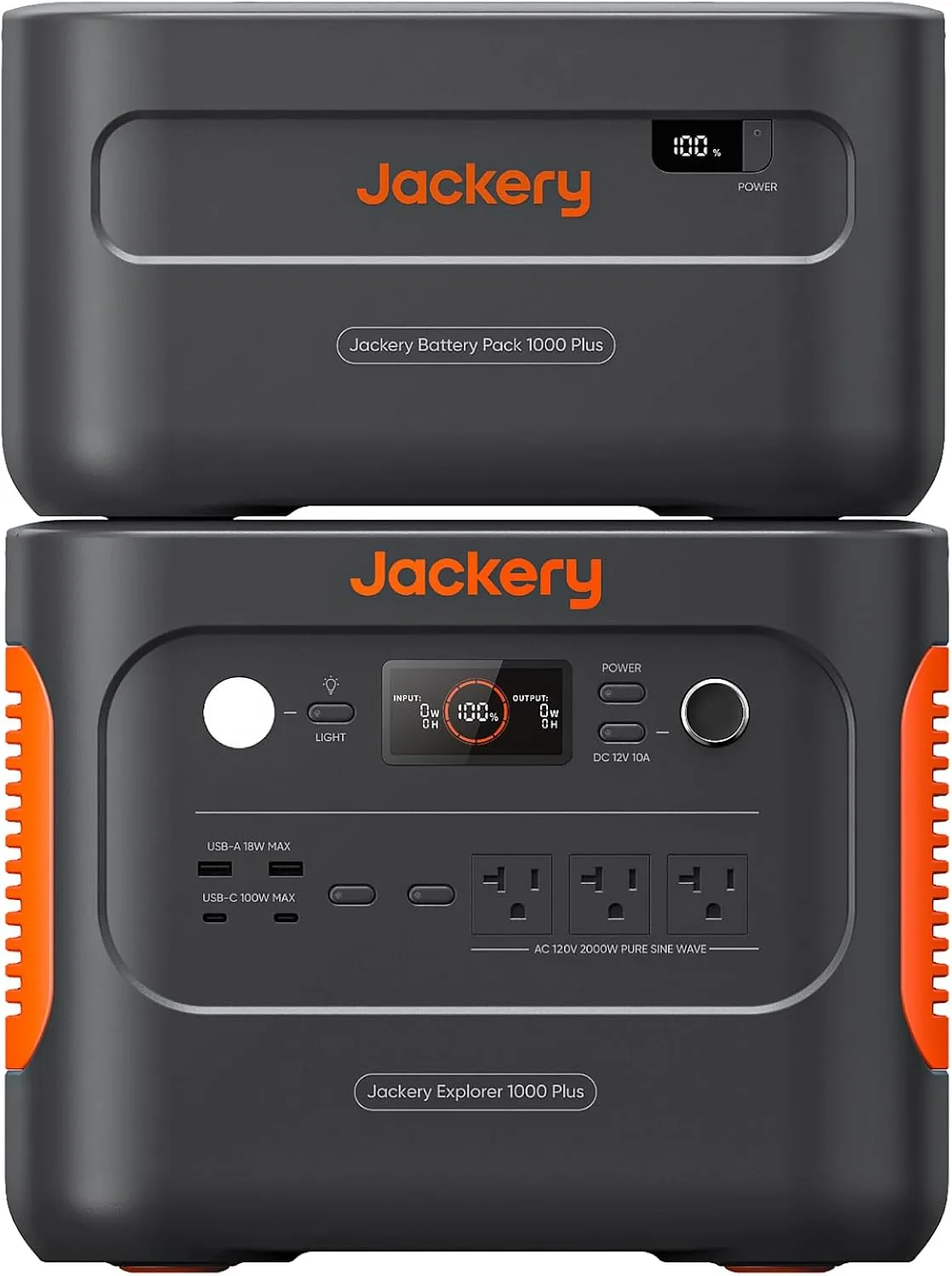
Jackery Explorer 1000 Plus Portable Power Station Kit - 2528Wh LiFePO4 Battery with
Highlights
- 1264Wh rated capacity
- 2000W continuous AC
- LiFePO4 chemistry
- 32 lb (~14.5 kg)
- About $1589 list
Best for
- Explorer 1000 Plus: small appliances and tools that need ~2000W continuous, not just phone charging
- Park-and-use backup — at 32 lb (~14.5 kg) this is a poor long hike companion
How this shortlist was weighed
I am a deep-use experience reviewer, and these picks come from home-user checks grounded in owner themes on file plus listing specs — not lab-bench measurements or an invented third-party score. I weighted four things: capacity and output fit for real outage and camping loads (35%), expansion cost and flexibility (25%), weight and portability (20%), and owner-reported reliability themes (20%). Every percentage above is scored in the ranking that follows.
The Anker C2000 Gen 2 takes the top spot because it wins on the two heaviest weights: it delivers 2,048 Wh and 2,400 W at the lowest nameplate $/Wh in the group ($0.49), and it still offers an expansion path to ~4 kWh. The EcoFlow DELTA 2 Max is a close second — same capacity and output, more ports, a 5-year warranty per listing, but $400 more and 8 lb heavier, which costs it on value and portability. The Jackery Explorer 1000 v2 ranks third on capacity but wins on weight and price for camping. The Explorer 1000 Plus ranks fourth because its base $/Wh is the worst here and its owner sample is thin; the expansion math is real, but you have to actually use it to justify the price.
Scoreboard on those weights — Anker C2000 Gen 2 Portable Power Station, 2,048Wh (list $999.99): High where list price and published capacity match the job, Med on continuous watts; EcoFlow DELTA 2 Max (list $1399): High on continuous watts and ports, Med on price. That is why the pick splits by job rather than one universal winner.
- Capacity/output fit: 35%
- Expansion cost and flexibility: 25%
- Weight and portability: 20%
- Owner-reported reliability themes: 20%
The expansion math
This is where the Explorer 1000 Plus earns or loses its price. Jackery sells add-on battery packs that stack onto the base, and the listing says the station supports up to three packs, taking capacity from 1.25 kWh to about 5 kWh. The kit version in this shortlist is listed at $1,589 for the 2,528 Wh configuration — that is the base plus one expansion pack, not the bare unit.
The per-kWh cost of expansion is the number that matters. At the $1,589 kit price for 2,528 Wh, you are paying about $0.63/Wh for the combined package. Compare that to the base unit's nameplate $1.26/Wh — expansion is dramatically cheaper per watt-hour than the base, which is the whole point of an expandable system. But you have to actually want the extra capacity, because the base alone at $1,589 for 1,264 Wh is the worst $/Wh in this group by a wide margin.
Weight and setup matter too. Each add-on pack adds bulk and a cable, and the stack is not something you toss in a trunk for a camping trip — it is a garage or closet resident. If you plan to carry the station, buy the base and skip the packs; if you plan to park it next to the fridge, the expansion path is the reason to choose this unit at all.
- Kit price: $1,589 for 2,528 Wh (~$0.63/Wh combined)
- Base-only nameplate: $1.26/Wh — highest in this shortlist
- Max expansion: ~5 kWh with three add-on packs (per listing)
- Expansion is a stay-put feature — stacked packs are not camping-portable
Where the money went
The Explorer 1000 Plus uses LiFePO4 cells, and the listing claims 4,000 cycles to 80% capacity — a 10-year-ish lifespan under normal use. That chemistry is the right call for a station that lives in a garage and gets cycled during outages; it tolerates full charges and hot garages better than NMC. The 2,000 W inverter is adequate for the base capacity, though the ratio is a little inverter-heavy: you can surge a coffee maker or a microwave, but the 1,264 Wh base will drain fast under those loads.
Build quality reads as solid from the listing and the two owner reviews on file — one owner compares it favorably to the larger Explorer 2000 Plus, another bought it specifically for fridge/freezer outage prep and reports the charge held at 100% after six months in the garage. That is a thin sample (13 ratings, 3.8 aggregate), so treat the durability picture as promising but unproven at scale.
The app is part of the value: Jackery's app controls charge modes, including a quiet overnight mode and an emergency fast-charge mode. What cheaper units skip is exactly this — app control, expandability, and the LiFePO4 cycle life. A $559 sealed unit gives you capacity and ports but no growth path.
- LiFePO4, 4,000 cycles to 80% per listing — right chemistry for garage backup
- 2,000 W inverter is slightly oversized for 1,264 Wh base — high-draw appliances drain fast
- App control (charge modes, quiet mode) is a real differentiator vs budget units
- Owner sample is thin: 13 ratings, 3.8 aggregate — durability unproven at scale
What is missing at this price
At $1,589 for the kit, the gaps are worth naming. The display and app give you state of charge and input/output watts, but the listing does not detail per-port wattage readouts or a granular battery-health screen — fine for most buyers, limiting if you like to audit loads. The bigger issue is the capacity-to-inverter ratio: 1,264 Wh behind a 2,000 W inverter means a 1,500 W load runs for well under an hour before you are at 20%. If your outage plan includes a space heater or a microwave, this base unit is the wrong tool regardless of expansion.
And to be clear about scope: this is a portable station, not a home backup system. It has no transfer switch, no smart panel integration, and no whole-home claim. It can keep a fridge and a few electronics alive during an outage; it cannot run your furnace, well pump, or central AC. Buyers who want those loads need a standby generator or a professionally installed battery system, not a 32 lb suitcase.
- No transfer switch or smart-panel integration — not a whole-home solution
- 1,264 Wh base is small for the 2,000 W inverter — high-draw loads drain fast
- Display detail is basic; no per-port wattage audit in the listing
- Expansion packs are sold separately — the $1,589 kit includes one, but check what's in the box
Cheaper and dearer neighbours
The most direct competitor is the EcoFlow DELTA 2 Max at $1,399. It gives you 2,048 Wh and 2,400 W in a sealed 50 lb unit — no expansion, but more base capacity and output for $190 less than the Jackery kit. It also has six AC ports and a 5-year warranty per the listing, and owner themes skew heavily toward power outages and backup, which matches this page's job. If you do not need to grow past 2 kWh, the DELTA 2 Max is the better value on nameplate $/Wh ($0.68 vs $1.26 for the Jackery base).
At the other end, the Jackery Explorer 1000 v2 Portable Power Station,1070Wh,1500W is $559 for 1,070 Wh and 1,500 W at just 23.8 lb. It is the camping and CPAP pick — light enough to carry, cheap enough to own as a second station, and it has USB-C×2 and a car port. It will not run a fridge as long as the 2 kWh units, but for tailgating, tent camping, or a CPAP backup it is the sensible spend. The Anker C2000 Gen 2 Portable Power Station, 2,048Wh at $999.99 is the value leader on nameplate $/Wh ($0.49) and also expands to ~4 kWh, so it undercuts the Jackery on both base price and expansion cost — though its port count is not fully specified in the listing.
| Product | List price | Capacity (Wh) | Output (W) | Weight (lb) | Rating |
|---|---|---|---|---|---|
| Anker C2000 Gen 2 Portable Power Station, 2,048Wh | $999.99 | 2048 Wh | 2400 W | 41.7 lb | 4.91 |
| EcoFlow DELTA 2 Max | $1,399 | 2048 Wh | 2400 W | 50 lb | 4.80 |
| Jackery Explorer 1000 v2 Portable Power Station,1070Wh,1500W | $559 | 1070 Wh | 1500 W | 23.8 lb | 4.75 |
| Jackery Explorer 1000 Plus Portable Power Station Kit - 2528Wh LiFePO4 | $1,589 | 1264 Wh | 2000 W | 32 lb | 4.91 |
Buy the base, the bundle, or neither
The decision rule is simple: buy the Explorer 1000 Plus kit only if you are sure you will add at least one more expansion pack later and you want a LiFePO4 station that lives in one place. The kit at $1,589 for 2,528 Wh is a fair deal on a per-Wh basis once you factor in the second pack, and the 4,000-cycle chemistry supports long-term garage duty. Pair it with solar only if you have a sunny spot and want the two-hour recharge — the listing's four-panel claim is a best-case number.
Buy the base unit alone only if you find it discounted well below the kit price and you genuinely need just 1.26 kWh. At list, the base is poor value: $1,589 for 1,264 Wh is $1.26/Wh, and the Anker C2000 Gen 2 gives you 2,048 Wh for $999.99 with its own expansion path.
Walk away if your outage plan includes a space heater, window AC, well pump, or anything above 2,000 W continuous — no portable station in this group will carry those loads, and the Jackery's small base makes it the worst fit for high-draw backup. Also walk away if you need to carry the station regularly: 32 lb plus an expansion pack is a two-hand garage appliance, not a camping companion. For carry-and-go use, the Explorer 1000 v2 at 23.8 lb is the right call.
- Buy the kit if: you will expand to 2.5–5 kWh and the station stays home
- Buy the base only if: discounted well below kit price and 1.26 kWh is genuinely enough
- Skip if: you need >2,000 W continuous, whole-home backup, or one-hand portability
- Cheaper alternative for camping: Jackery Explorer 1000 v2 at $559, 23.8 lb
- Better sealed value at 2 kWh: Anker C2000 Gen 2 at $999.99 or EcoFlow DELTA 2 Max at $1,399
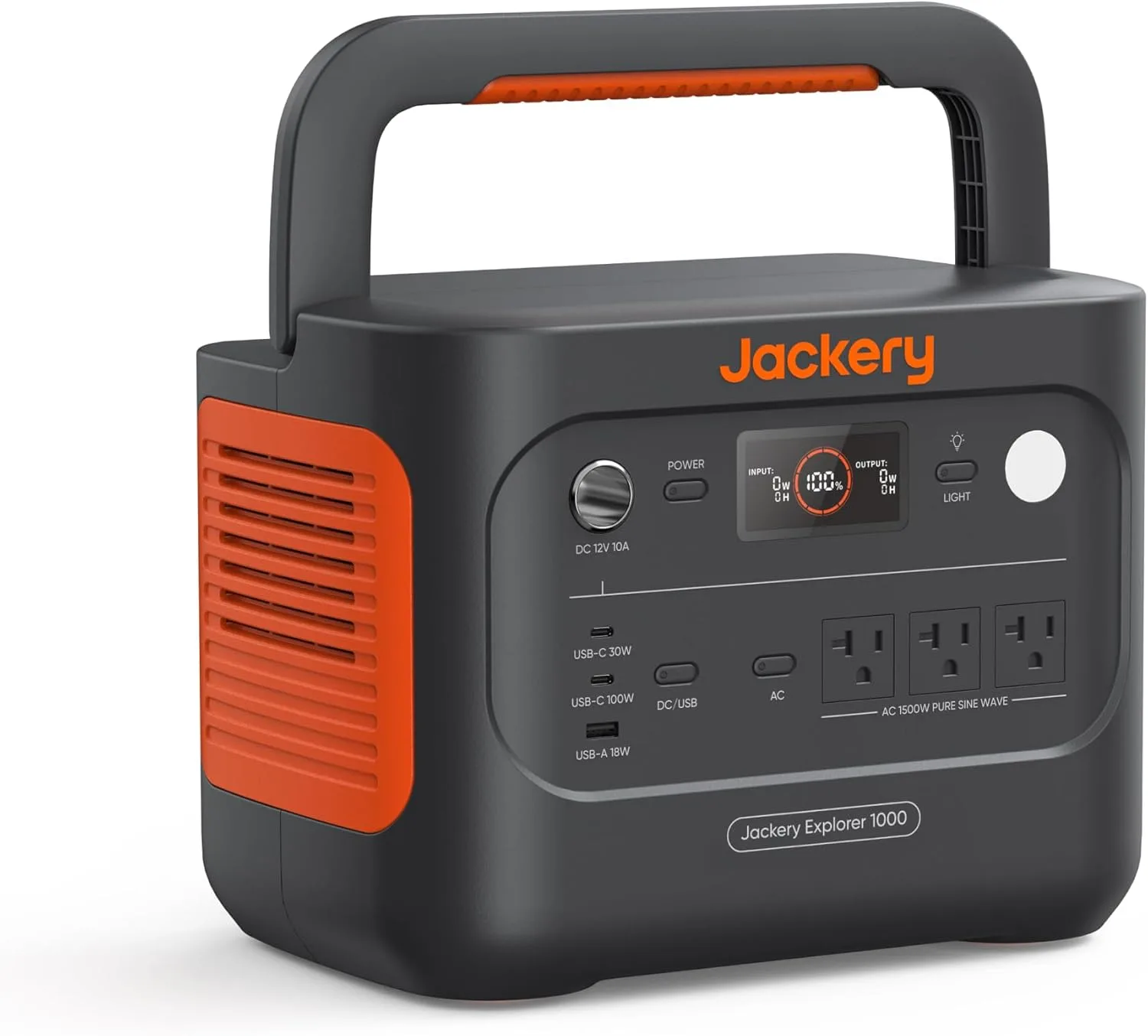
Jackery Explorer 1000 v2 Portable Power Station,1070Wh,1500W
Highlights
- 1070Wh rated capacity
- 1500W continuous AC
- LiFePO4 chemistry
- Up to 400W solar input
- 23.8 lb (~10.8 kg)
- About $559 list
Best for
- Explorer 1000 v2: weekend camping when 23.8 lb carry weight matters as much as 1070Wh
- Essentials bridge at home (fridge cycles, router) when sized to the Wh
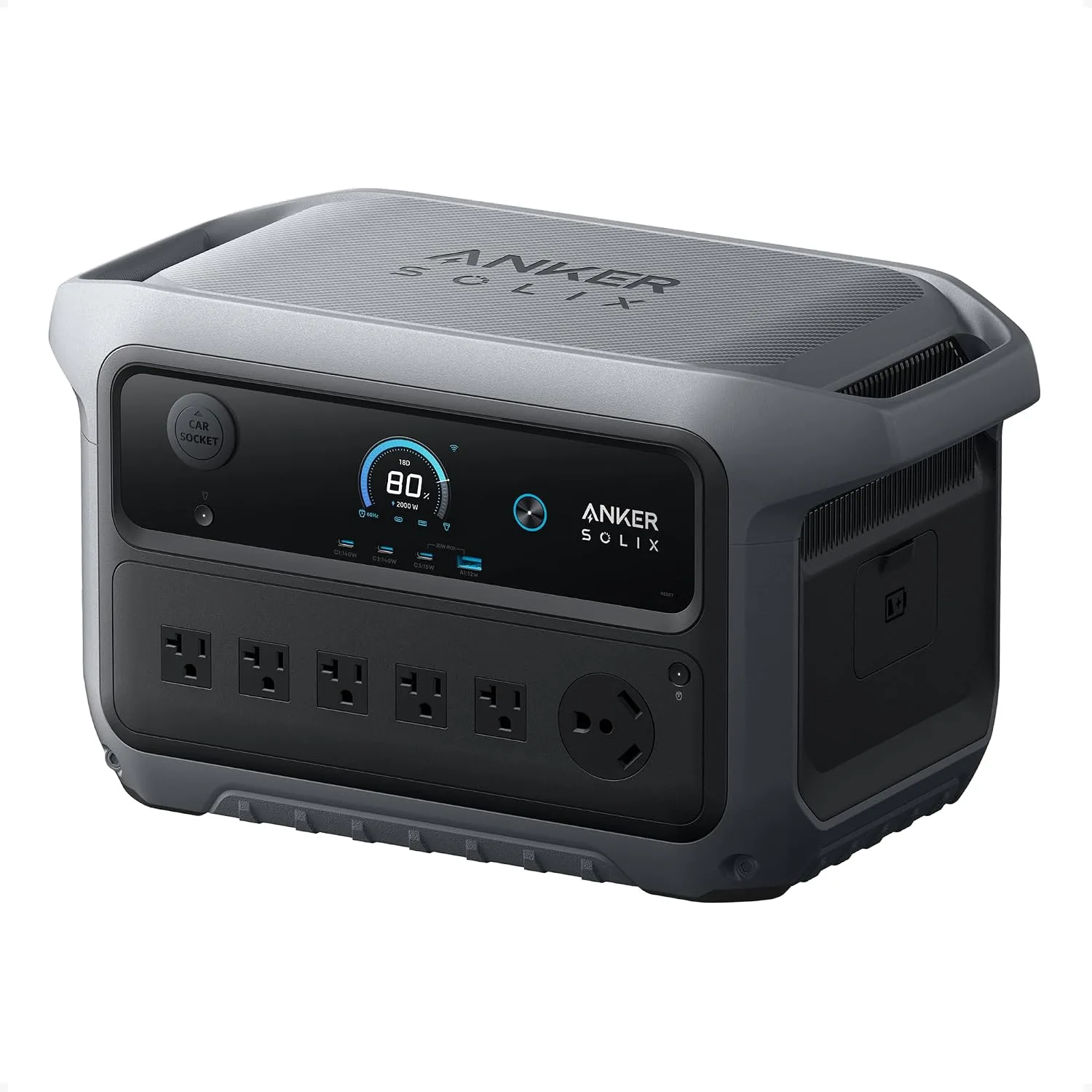
Anker C2000 Gen 2 Portable Power Station, 2,048Wh
Highlights
- 2048Wh rated capacity
- 2400W continuous AC
- 4000W surge
- LiFePO4 chemistry
- Up to 800W solar input
- 41.7 lb (~18.9 kg)
Best for
- C2000 Gen 2: longer outages or higher continuous loads (still not whole-home wiring)
- RV / off-grid days where recharge speed matters as much as Wh
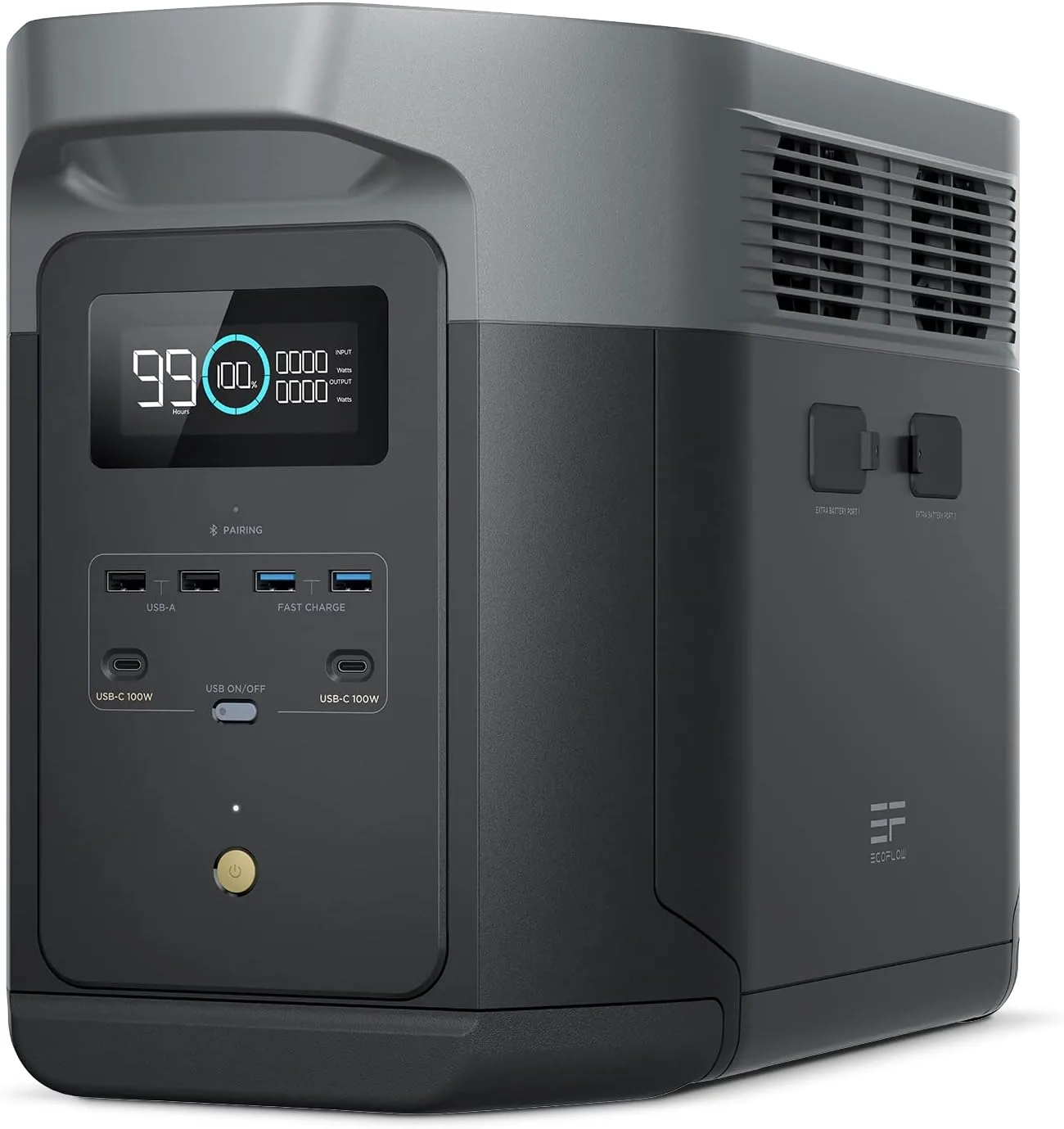
EcoFlow DELTA 2 Max
Highlights
- 2048Wh rated capacity
- 2400W continuous AC
- 4800W surge
- LiFePO4 chemistry
- Up to 1000W solar input
- 50 lb (~22.7 kg)
Best for
- DELTA 2 Max: longer outages or higher continuous loads (still not whole-home wiring)
- RV / off-grid days where recharge speed matters as much as Wh
The four stations, ranked
#1 — Anker C2000 Gen 2 Portable Power Station, 2,048Wh ($999.99). Suits buyers who want the most watt-hours per dollar with a path to ~4 kWh. Skip if you need a fully specified port count — the listing does not detail USB-C/USB-A quantities, so confirm before buying. Owner themes center on refrigeration, camping, and electronics, with several noting it fits under a counter for storage.
#2 — EcoFlow DELTA 2 Max ($1,399). Suits outage-focused buyers who want 2,048 Wh, 2,400 W, six AC ports, and a 5-year warranty per listing. Skip if $400 over the Anker matters or you need to carry it — 50 lb is the heaviest here. Owner themes skew to power outages and backup, which matches this page's job.
#3 — Jackery Explorer 1000 v2 Portable Power Station,1070Wh,1500W ($559). Suits campers, CPAP users, and anyone who needs a 23.8 lb station that charges in about an hour. Skip if you need to run a fridge for more than half a day — 1,070 Wh is the smallest capacity here. Owner themes center on camping and kitchen appliances.
#4 — Jackery Explorer 1000 Plus Portable Power Station Kit - 2528Wh LiFePO4 ($1,589). Suits buyers who will expand to 2.5–5 kWh and keep the station in one place. Skip if you need value at the base capacity or a proven owner track record — the 3.8 aggregate from 13 ratings is thin.
What owners actually report
Owner themes are theme-level summaries from the review highlights on file, not raw quotes. The pattern across the group is that buyers care most about outage reliability and fridge runtime, and the 2 kWh units get the most positive backup stories. The Explorer 1000 Plus has the thinnest sample — two reviews on file, one comparing it to the larger 2000 Plus and one on fridge/freezer prep — so its 3.8 aggregate should be read as early signal, not a verdict.
- Anker C2000 Gen 2: refrigeration and camping themes dominate — owners report running a TV, fridge, and WiFi for over 10 hours and fast recharge.
- EcoFlow DELTA 2 Max: outage and backup themes lead — owners mention powering a furnace for hours and 0–100% in about 1 hr 15 min.
- Jackery Explorer 1000 v2: camping and kitchen-appliance themes — owners report a side-by-side fridge/freezer for up to 9 hours and CPAP use.
- Jackery Explorer 1000 Plus: thin sample — one owner compares it to the 2000 Plus; another reports charge held at 100% after six months in the garage.
Frequently asked
How long will the Explorer 1000 Plus run a fridge?
With a typical 60–80 W fridge cycling at about 50% duty, expect roughly 12–16 hours from the 1,264 Wh base. Add an expansion pack and you roughly double that. This is an estimate from capacity and typical draw, not a measured runtime.
Can the Explorer 1000 Plus run a space heater?
No — most space heaters draw 1,500 W, which is within the 2,000 W continuous rating but will drain the 1,264 Wh base in well under an hour. It is not a practical heater solution.
Is the Anker C2000 Gen 2 really cheaper per Wh than the Jackery kit?
Yes, on nameplate: $0.49/Wh vs $1.26/Wh for the Jackery base. The Jackery kit's combined $/Wh improves to about $0.63 when you count the included expansion pack, but the Anker is still cheaper and has more base capacity.
Method and sources
Model names and list prices come from the WattPicks catalog at build time. WattPicks does not run its own laboratory tests on power stations, and nothing on this page is presented as a measured result — it is catalog-backed buying guidance.
Read our methodology for how the catalog is normalized, and about WattPicks for who publishes it.