
Use case
Best portable power stations for mobile work and creators
Creators care about port compatibility, noise and clean sine-wave output more than raw capacity. Here are the specs that matter for a desk, a camera cart or a shoot day.
Who this is for
- Photographers and videographers on location
- Remote workers who cannot lose a call or a render
- Trades and consultants working where there is no outlet
What actually decides the buy
- UPS switchover time. The spec that decides whether a desktop survives a brownout.
- Pure sine-wave AC output. Sensitive electronics and audio gear want a clean waveform.
- USB-C PD wattage. The fastest path to charge a modern laptop without an AC brick.
- Port quantity and mix. A shoot day has many small loads, not one big one.
- Noise. A unit that whines under load is a problem in a quiet room.
Sizing bands
| Band | Rated Wh | What it buys |
|---|---|---|
| Desk | 300–700 Wh | Laptop, monitor, router for most of a day. |
| Shoot day | 700–1500 Wh | Multiple battery recharges plus lighting. |
| Cart / multi-day | 1500–3000 Wh | A DIT cart or a multi-day location shoot. |
Common traps
- Buying capacity when the real requirement is switchover time and port mix
- Assuming any inverter is fine for audio gear — waveform matters
- Under-buying USB-C wattage and then needing AC bricks anyway
- Ignoring how loud the unit is in a small room
Brands that serve this job
- EcoFlow — Strong UPS behavior, high USB-C output and app monitoring.
- DJI — Dedicated fast-charge ports for DJI gear and very fast AC recharge.
- Anker SOLIX — Consumer-electronics-grade charging behavior and a good app.
- Jackery — Simple and reliable for a straightforward desk-backup job.
Guides & compares in this cluster
All guides →Primary guide: start with the featured pick below. Other roundups in this cluster are branches — same job, narrower lens (e.g. solar-kit or overnight-only cuts).
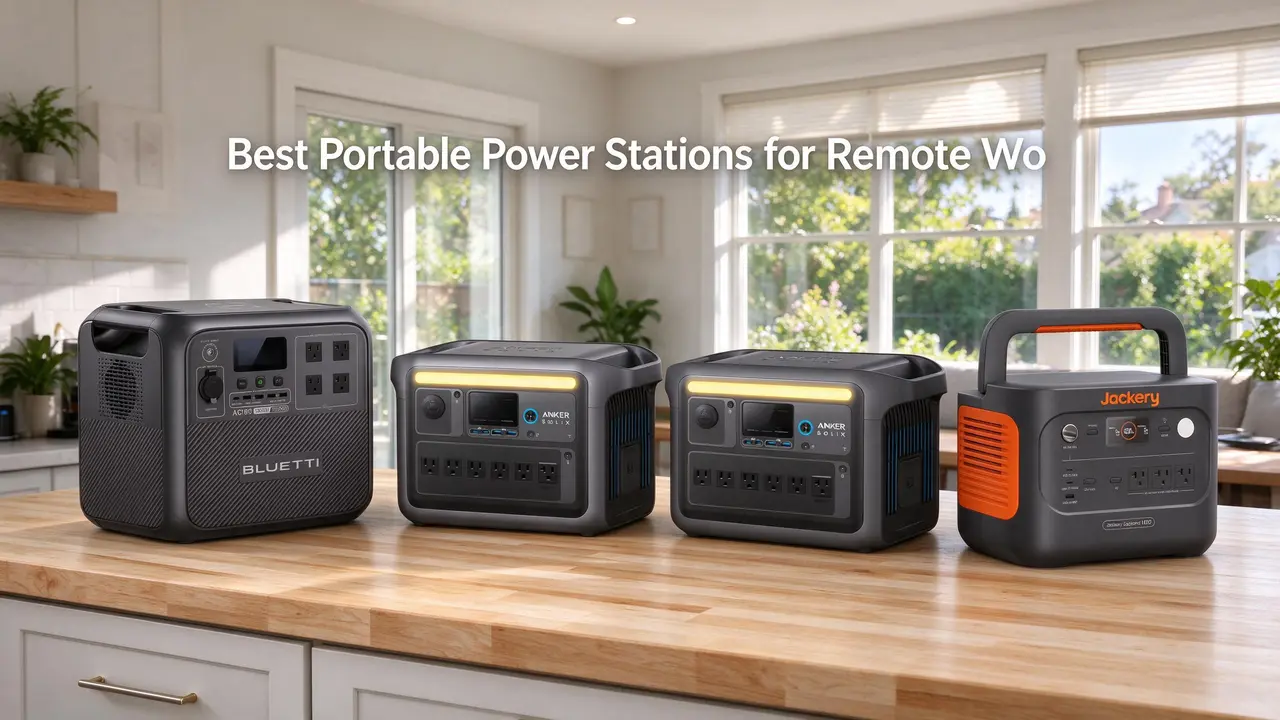
Best Portable Power Stations for Remote Work: 5 Picks Ranked
 By Noah KimUpdated
A remote-work power station has to run a laptop, monitor, router, and phone for a full day — then recharge fast enough to do it again. I ranked five desk-class units on usable watt-hours, continuous output, and real owner runtime, with the BLUETTI AC180 taking the value crown.
Read More