
Jackery Explorer 1000 v2 Review: Value 1.5kWh LFP?
The Jackery Explorer 1000 v2 packs 1,070 Wh of LiFePO4 into 23.8 lb for $559 — about $0.52 per nameplate Wh. Here's where that math holds up, and where the 1,500 W ceiling and missing expandability bite.
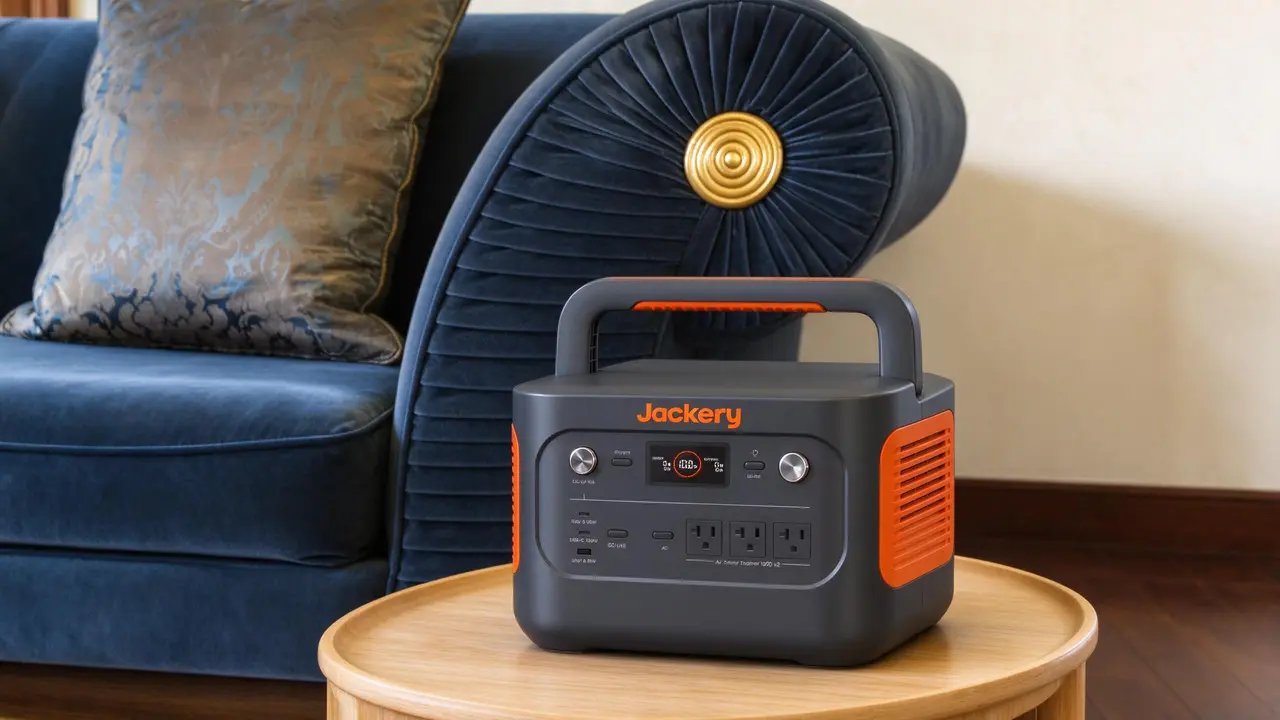
Updated
At a glance
The Jackery Explorer 1000 v2 packs 1,070 Wh of LiFePO4 into 23.8 lb for $559 — about $0.52 per nameplate Wh. Here's where that math holds up, and where the 1,500 W ceiling and missing expandability bite.
- Capacity: 1,070 Wh LiFePO4
- AC output: 1,500 W continuous / 3,000 W surge
- Weight: 23.8 lb
- List price: $559 → ~$0.52/Wh nameplate
The $699 question, answered with $559 math
As an Amazon Associate I earn from qualifying purchases. Recommendations here are based on fit and the evidence below — not commission size.
Short answer: at the $559 list price on file, the Jackery Explorer 1000 v2 Portable Power Station,1070Wh,1500W works out to about $0.52 per nameplate Wh — the number to beat if you're shopping a ~1kWh LiFePO4 station. That's the value case in one line. The caveat is that this is a 1,070 Wh unit, not a 1.5 kWh one, so if your load math needs 1,500 Wh of headroom, this isn't your station.
The title asks whether it's the best value 1.5kWh LFP station. On the facts we have, it's a strong value in the 1kWh class — 1,070 Wh, 1,500 W continuous, 23.8 lb, LiFePO4 — but it doesn't belong in a 1.5kWh comparison. I'd rather say that plainly than stretch the label. If you need 1,500 Wh, size up; if 1,070 Wh covers your loads, the $/Wh here is hard to argue with.
- Capacity: 1,070 Wh LiFePO4
- AC output: 1,500 W continuous / 3,000 W surge
- Weight: 23.8 lb
- List price: $559 → ~$0.52/Wh nameplate
- Ports: AC×3, USB-C×2, USB-A×1, car×1
Spec snapshot: what $559 buys
Here's the full card, straight from the listing data. Nothing here is a lab measurement — it's what Jackery publishes and what the Hub catalogue locks.
The 3,000 W surge figure matters for motor loads like a fridge compressor kicking on. It is not continuous output; don't plan around it for sustained draws.
| Product | Capacity | Continuous AC | Surge | Weight | Ports | List price | $/Wh (nameplate) | Rating |
|---|---|---|---|---|---|---|---|---|
| Jackery Explorer 1000 v2 Portable Power Station,1070Wh,1500W | 1,070 Wh | 1,500 W | 3,000 W | 23.8 lb | AC×3; USB-C×2; USB-A×1; car×1 | $559 | $0.52/Wh | 4.75 |
Why LiFePO4 at this price changes the ownership math
The listing claims over 70% capacity after 4,000 cycles and a lifespan exceeding 10 years. Treat those as published figures, not tested ones. But the chemistry itself is the point: LiFePO4 tolerates deep discharges and heat better than NMC, which is what you want in a garage or car trunk. At $559, you're getting that chemistry without paying a premium tier.
The buyer impact is simple. An NMC pack at the same price would likely have a shorter cycle life and a narrower thermal comfort zone. LiFePO4 means you can leave it plugged in, cycle it hard on camping weekends, and not baby it. That's worth real money over five to ten years, even if the sticker doesn't show it.
- Published cycle claim: 4,000 cycles to >70% capacity
- Chemistry: LiFePO4 (listing)
- No battery expansion support — plan capacity up front
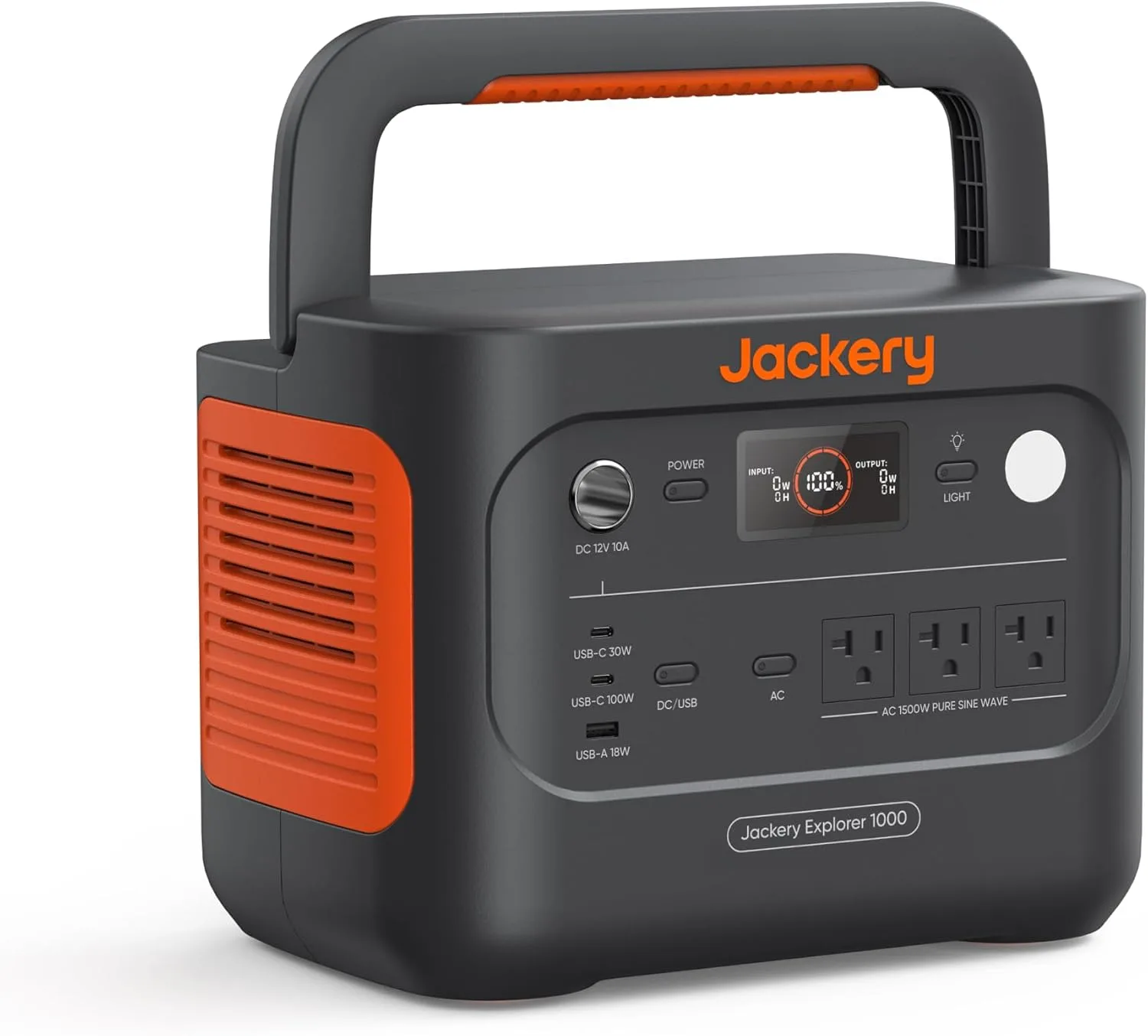
Jackery Explorer 1000 v2 Portable Power Station,1070Wh,1500W
Highlights
- 1070Wh rated capacity
- 1500W continuous AC
- LiFePO4 chemistry
- Up to 400W solar input
- 23.8 lb (~10.8 kg)
- About $559 list
Best for
- Explorer 1000 v2: weekend camping when 23.8 lb carry weight matters as much as 1070Wh
- Essentials bridge at home (fridge cycles, router) when sized to the Wh
Charging: the 1-hour claim vs. the 1.7-hour default
The listing says 0–100% in about one hour with emergency charging enabled via the Jackery app, and about 1.7 hours in the default mode. Owners on file back that up loosely: one long-term reviewer reports roughly 1 hour 40 minutes in normal mode, and another says it recharges within an hour on boost. That's consistent enough to trust the ballpark.
What the listing doesn't give you is a solar charge time. Up to 400 W MPPT input is on the card, but actual solar hours depend on panel and sun — I won't invent a number. If off-grid recharge speed is your deciding factor, budget for panels and expect slower than wall charging.
- Wall charge: ~1 hr (emergency mode, app) / ~1.7 hr default
- Solar input: up to 400 W MPPT (charge time n/a on file)
- App modes: emergency, quiet (~30 dB), efficiency
What 1,070 Wh actually runs — load math, not vibes
Runtime is capacity divided by average draw, minus inverter losses. Using the nameplate 1,070 Wh and a rough 85% usable assumption for planning, you're working with about 910 Wh of practical energy. A typical home fridge/freezer pulls 100–200 W average when cycling, so 4.5–9 hours is the honest band. Owners report a side-by-side fridge/freezer for up to 9 hours and a 12-quart DC fridge for three days in eco mode — both fit that math.
For smaller loads, the numbers stretch. A 50 W CPAP plus phone charging overnight is comfortably inside one night. A 500 W hot plate for 20 minutes is about 170 Wh — fine. A 1,700 W air fryer is over the 1,500 W continuous ceiling and won't run; one owner found that out the hard way. The 1,500 W limit is the real gate, not the Wh.
- Fridge/freezer (100–200 W avg): ~4.5–9 hr
- CPAP + phones (50–80 W): overnight, with margin
- 12V DC cooler in eco mode: multi-day per owner reports
- 1,700 W air fryer: no — exceeds 1,500 W continuous
Portability: 23.8 lb is the real selling point
At 23.8 lb with a foldable handle, this is a one-hand carry for most adults and a two-hand carry for some. That's light for a 1kWh LiFePO4 station, and owners consistently call out the handle and weight as reasons it actually leaves the garage. One reviewer notes anything over 25 lb becomes only marginally portable — this sits just under that line.
The trade-off is no IP rating. Don't leave it in the rain. For car camping and tailgates that's fine; for a permanent outdoor install, it isn't the right tool.
- Weight: 23.8 lb (14.5 kg class)
- Foldable handle — owners cite easy carry
- No IP rating — keep it dry
- No expansion battery support
Where it earns the value label — and where it doesn't
Buy it if you want a ~1kWh LiFePO4 station that charges fast from the wall, weighs under 25 lb, and costs about $0.52 per nameplate Wh. It fits camping, tailgates, CPAP backup, and short outage coverage for a fridge and a few fans.
Skip it if you need 1,500 Wh of capacity, expandability, an IP rating, or more than 1,500 W continuous for appliances like a full-size air fryer or a large miter saw. One owner found the 12-inch sliding miter saw stalled it immediately. That's not a defect — it's the ceiling doing its job.
- Buy if: 1,070 Wh covers your loads and you value light weight + fast wall charging
- Skip if: you need expansion, weather sealing, or >1,500 W continuous
- Skip if: you're specifically shopping the 1.5 kWh class — this is 1,070 Wh
Owner themes worth knowing before you buy
The reviews on file skew toward home backup and camping, which matches this page's angle. Fast charging and fridge runtime come up repeatedly. The app's quiet mode gets consistent praise for overnight use. A few owners mention the buttons sit deep in the case and are easy to leave on — minor, but real.
One recurring note: the emergency one-hour charge reverts to normal mode after each use, so most owners just live in the default ~1.7-hour mode. That's a useful expectation-setter if the 1-hour headline is what pulled you in.
- Fast wall charging (~1.5–2 hr default) — frequently cited
- Fridge/freezer runtime — owners report 9 hr to multi-day depending on load
- Quiet mode praised for overnight; buttons easy to leave on
- No car charger included — one owner wished it were
The verdict: value in the 1kWh class, not the 1.5kWh one
The Jackery Explorer 1000 v2 Portable Power Station,1070Wh,1500W is a genuinely good value at $559 — light, fast-charging, LiFePO4, and about $0.52 per nameplate Wh. It answers the value question well. It does not answer the 1.5 kWh question, because it isn't a 1.5 kWh station.
If your loads fit inside 1,070 Wh and 1,500 W, buy it. If they don't, no amount of $/Wh math will fix the gap. Size for the load first, then let price break the tie.
Frequently asked
Is $559 a good price for 1,070 Wh of LiFePO4?
On nameplate math, yes — about $0.52/Wh. Historical lows have hit $499, so if you're not in a hurry, watch for a sale. But at list, the value case holds.
Can it run a fridge overnight?
Usually yes, if the fridge averages under ~150 W. A side-by-side cycling at 100–200 W gives you roughly 4.5–9 hours from the ~910 Wh practical estimate. Owners report up to 9 hours.
Will it run a 1,500 W space heater?
At exactly 1,500 W continuous, you're at the ceiling — not a comfortable margin. I'd size up or use a lower-wattage heater.
Does it support expansion batteries?
No. The listing confirms no battery expansion support, so buy the capacity you need up front.
Method and sources
Model names and list prices come from the WattPicks catalog at build time. WattPicks does not run its own laboratory tests on power stations, and nothing on this page is presented as a measured result — it is catalog-backed buying guidance.
Read our methodology for how the catalog is normalized, and about WattPicks for who publishes it.