
Goal Zero Yeti 1500 vs Jackery Explorer 1500 v2
Two 1,500Wh-class stations with the same 2,000W ceiling and a $700 gap between them. One bets on fast recharge and port count, the other on price per watt-hour and a lighter shell — here is which bet pays off for your outage or campsite.
Updated
At a glance
Two 1,500Wh-class stations with the same 2,000W ceiling and a $700 gap between them. One bets on fast recharge and port count, the other on price per watt-hour and a lighter shell — here is which bet pays off for your outage or campsite.
- Jackery's bet: $0.52/Wh nameplate, 32 lb, LiFePO4 rated 6,000 cycles to 70%+
- Goal Zero's bet: $1.00/Wh nameplate, 52.8 lb, LiFePO4 rated 4,000 cycles, 4 AC + 4 USB-C + car port
Same money class, two different bets
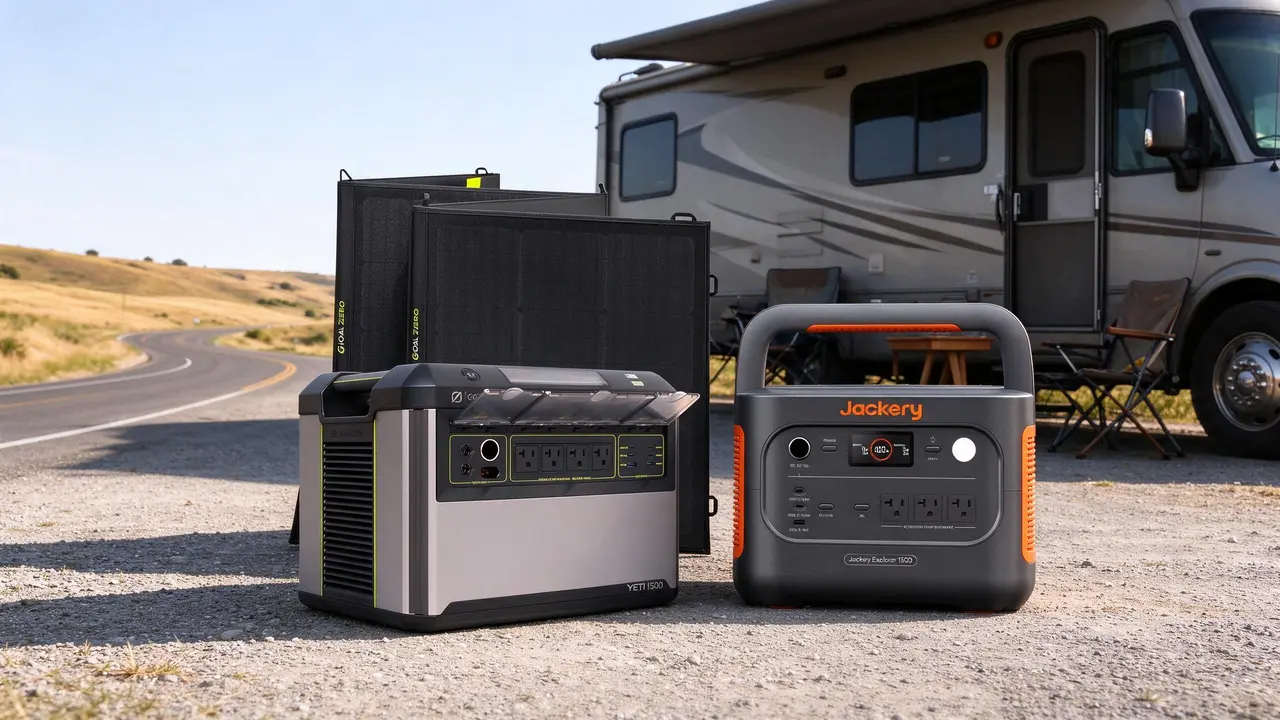
If you are shopping the 1,500Wh band, these two land at the same output ceiling — 2,000W continuous on both — but they spend your money very differently. The Jackery Explorer 1500 v2 bets on price per watt-hour and a lighter body. The Goal Zero Yeti 1500 bets on recharge speed, port count, and a rugged aluminum shell.
That is the whole decision in one line: do you want the cheaper, lighter box, or the faster-cycling, better-connected one? Neither is a whole-home solution — this is a fridge-and-a-few-circuits class of station, not a panel upgrade. Solar panels are sold separately for both, so budget for that if off-grid charging matters.
- Jackery's bet: $0.52/Wh nameplate, 32 lb, LiFePO4 rated 6,000 cycles to 70%+
- Goal Zero's bet: $1.00/Wh nameplate, 52.8 lb, LiFePO4 rated 4,000 cycles, 4 AC + 4 USB-C + car port
How I weighed these two
I am Avery Nolan, WattPicks founding editor, and I compare portable power stations on capacity, output, and price per Wh across the catalogue — no lab claims. This comparison leans on the listing specs in the product data plus the owner themes on file, and those checks are home-user observations, not lab-bench measurements.
My weighting for this pair: price per Wh 30%, weight and portability 25%, recharge speed 20%, port selection 15%, owner-reported reliability and support 10%. On that scale the Jackery wins price and weight, the Yeti wins recharge and ports, and the owner-reliability weight tilts toward the Yeti's documented outage use — but its support friction and the single overheating report keep that edge from being clean.
As an Amazon Associate I earn from qualifying purchases. Picks here are fit-led, not commission-led. For more on sizing a station to your loads, see our guide to portable power station capacity and our explainer on LiFePO4 versus NMC chemistry.
Here is the weighted arithmetic behind the pick, using the 30/25/20/15/10 weights above. Jackery Explorer 1500 v2 (list $799.95): price per Wh 30% × High (3) = 0.90; weight 25% × High (3) = 0.75; recharge 20% × Med (2) = 0.40; ports 15% × Med (2) = 0.30; reliability 10% × Low (1) = 0.10. Weighted total = 2.45 out of 3.00. Goal Zero Yeti 1500 (list $1499.95): price per Wh 30% × Low (1) = 0.30; weight 25% × Low (1) = 0.25; recharge 20% × High (3) = 0.60; ports 15% × High (3) = 0.45; reliability 10% × Med (2) = 0.20. Weighted total = 1.80 out of 3.00. The Jackery's 2.45 vs the Yeti's 1.80 is why the default pick is the Jackery unless recharge speed and port count are must-haves.
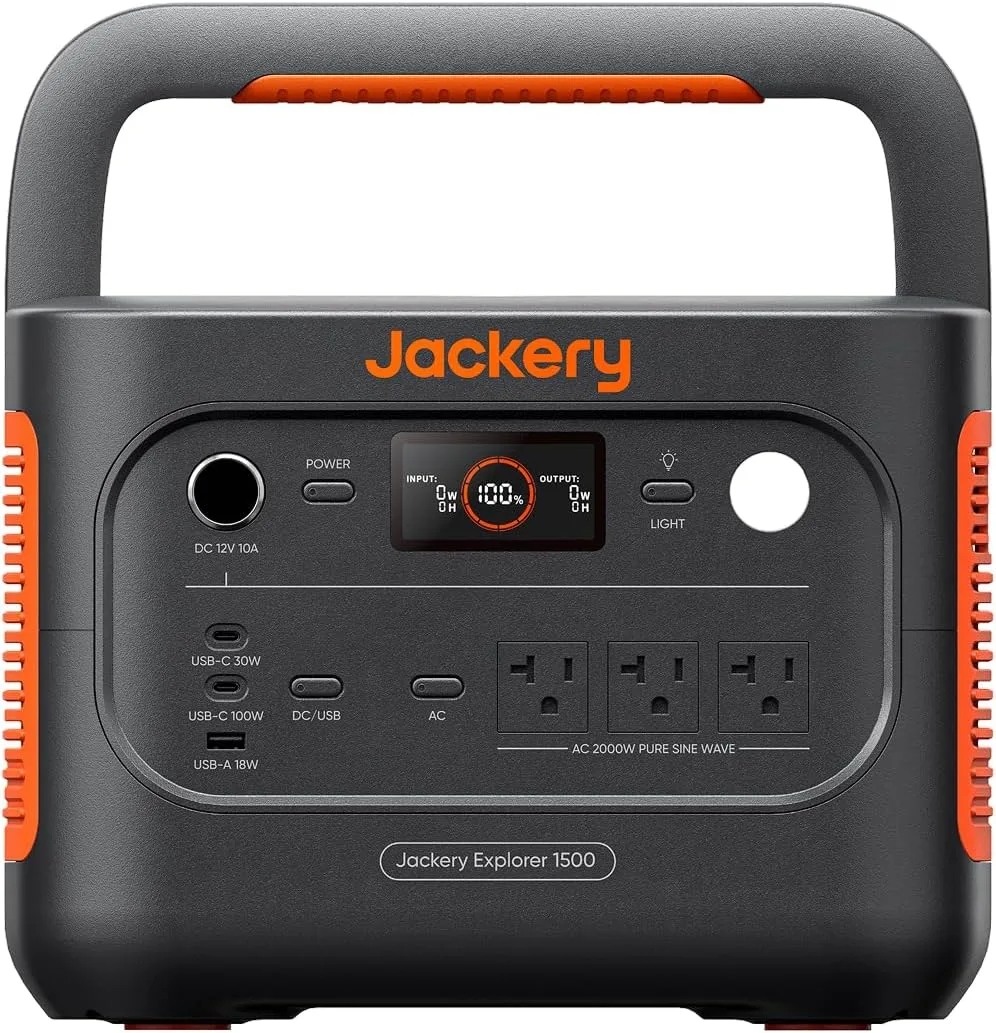
Jackery Explorer 1500 v2 Power Station,1536Wh,2000W Output
Highlights
- 1536Wh rated capacity
- 2000W continuous AC
- 4000W surge
- LiFePO4 chemistry
- 32 lb (~14.5 kg)
Best for
- Explorer 1500 v2: longer outages or higher continuous loads (still not whole-home wiring)
- RV / off-grid days where recharge speed matters as much as Wh
- Users who will pair solar or expand rather than buy a second small pack
Strengths
- Explorer 1500 v2: 1536Wh pack with 2000W continuous / 4000W surge — size loads to both numbers
- 32 lb (~14.5 kg) is a park-and-use chassis — plan a short path, not a trail hike
- 10ms-class UPS switchover on the listing — useful when a router restart would hurt
- Owners on file: Terrible product and company. Destructive service and defective products -- don't buy Jackery. Buy Ecoflow in…
Watch-outs · not ideal when
- 32 lb (~14.5 kg) is a two-hand lift; skip it if you walk more than a short path to camp
- High continuous output on Explorer 1500 v2 tempts big loads — Wh still runs out on kettles and A/C
- Solar input unpublished for Explorer 1500 v2 — do not assume a same-day off-grid refill
- LiFePO4 helps longevity, but Explorer 1500 v2 still hates freezing charge temps on winter trips
Owner voices
Short takes from public retail reviews — paraphrased or translated when long or non-English; meaning kept close to the original.
“1/5 — Terrible product and company. Destructive service and defective products -- don't buy Jackery. Buy Ecoflow instead -- their customer support arent insane and won't try to deny how shipping policies work in Canad…”
“4.6/5 — -5%$28.07 Typical price: $29.69 Get it as soon as Saturday, Oct 31 FREE Shipping on orders over $35 shipped by Amazon ZOUPW 200W Portable Solar Panel for Power Station,23.5% Efficiency | Mono Foldable Solar Pa…”
“4.4/5 — Amazon's Choice $189.99 Get it as soon as Saturday, Oct 31 FREE Shipping by Amazon Portable Carrying Bag Compatible with Jackery Explorer 1000 V2, Soft Power Station Storage Case with Padding, Generator Cover…”
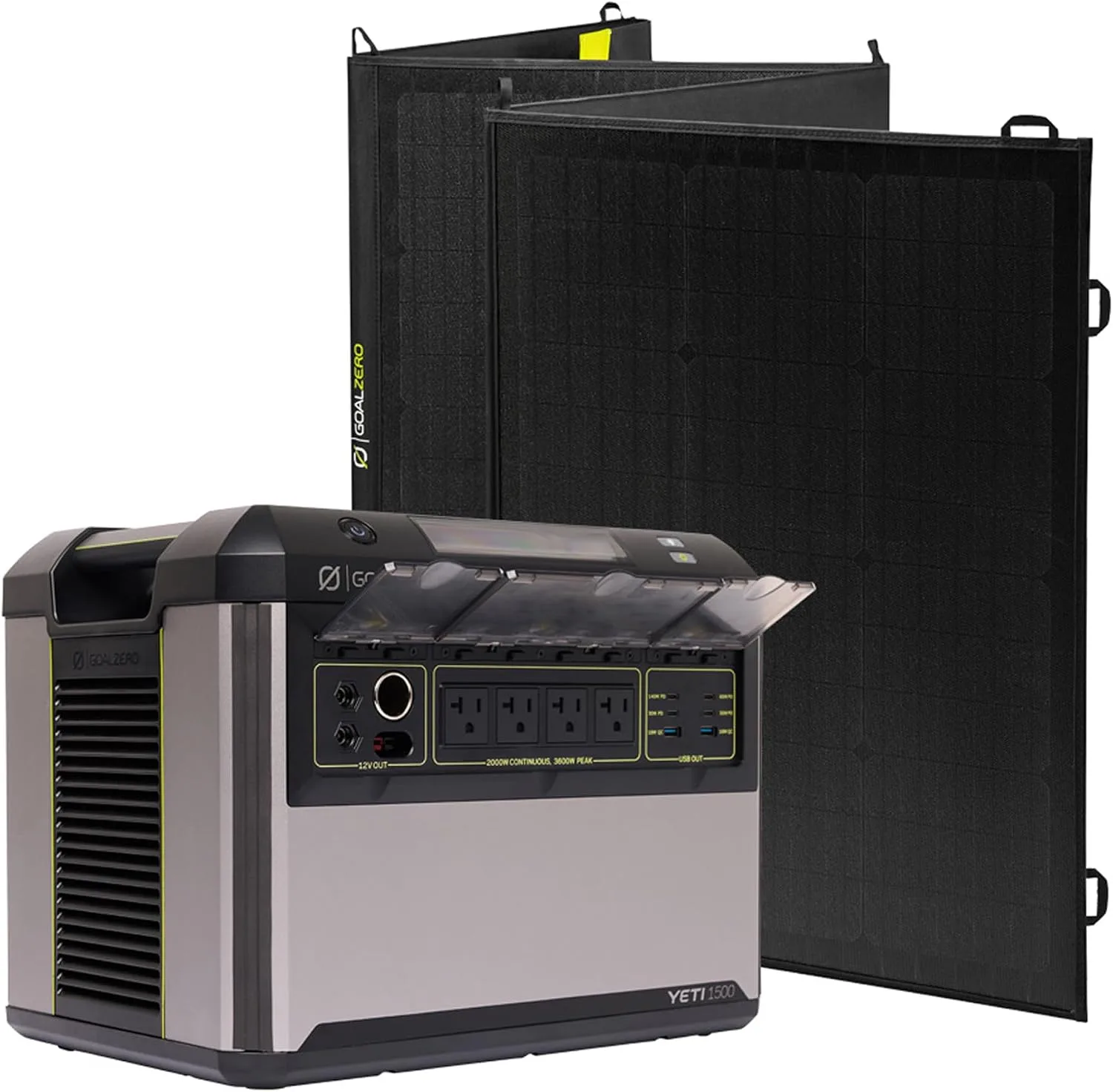
Goal Zero Yeti 1500 Portable Power Station
Highlights
- 1505Wh rated capacity
- 2000W continuous AC
- 3600W surge
- LiFePO4 chemistry
- Up to 900W solar input
- 52.8 lb (~23.9 kg)
Best for
- Yeti 1500: longer outages or higher continuous loads (still not whole-home wiring)
- RV / off-grid days where recharge speed matters as much as Wh
- Best parked near the vehicle or cabin — not a long carry to a tent
Strengths
- Yeti 1500: 1505Wh pack with 2000W continuous / 3600W surge — size loads to both numbers
- 52.8 lb (~23.9 kg) is a park-and-use chassis — plan a short path, not a trail hike
- 15ms-class UPS switchover on the listing — useful when a router restart would hurt
- Owners on file: 5/5 · 6 helpful — Without a doubt Goal Zero's best power station yet. I've been a customer for many years and…
Watch-outs · not ideal when
- At 52.8 lb (~23.9 kg), Yeti 1500 is a poor tent-hike companion — plan a cart or leave it in the vehicle
- High continuous output on Yeti 1500 tempts big loads — Wh still runs out on kettles and A/C
- Rated 900W solar on Yeti 1500 is optimistic; shade and cables cut real watts
- LiFePO4 helps longevity, but Yeti 1500 still hates freezing charge temps on winter trips
Owner voices
Short takes from public retail reviews — paraphrased or translated when long or non-English; meaning kept close to the original.
“5/5 · 6 helpful — Without a doubt Goal Zero's best power station yet. I've been a customer for many years and always find the products to be durable and reliable. Happy to report this new station continues the trend.…”
“5/5 · 5 helpful — Enjoying using my Goal Zero Yeti 1500. The unit recharges in an hour or less and provides quiet power for several days. Running power tools and various chargers works flawlessly. End result is to use…”
“5/5 · 4 helpful — We love the Yeti 1500 Portable Power Station. When the power goes out, we no longer need to fire up the gas-powered generator and run a cord from outdoors. We simply plug in an appliance, light, comp…”
Spec snapshot
Prices are list prices from the product data, not sale stickers. Ratings are the listing aggregate only — not owner proof, and the Explorer 1500 v2 pack is thin.
| Product | Price | Capacity (Wh) | Output (W) | Weight (lb) | Rating |
|---|---|---|---|---|---|
| Jackery Explorer 1500 v2 | $799.95 | 1536 Wh | 2000 W | 32 lb | 3.6 |
| Goal Zero Yeti 1500 | $1499.95 | 1505 Wh | 2000 W | 52.8 lb | 4 |
Where the money went
Line the two up on configuration and the $700 gap starts to explain itself — or fail to. Capacity is a wash: 1,536Wh versus 1,505Wh is a rounding error in real use. Output is identical at 2,000W continuous, so neither wins a load contest on paper.
Weight is where they split hard. The Jackery is 32 lb; the Yeti is 52.8 lb. That 20-plus-pound difference is the difference between carrying it up stairs solo and thinking twice. If you plan to move it between a garage, a shed, and a campsite, the Jackery is the friendlier object.
Ports flip the other way. The Yeti lists 4 AC, 4 USB-C, 2 USB-A, and a 12V car outlet. The Jackery lists 3 AC and 2 USB-C, with USB-A not on file — I will not claim it lacks USB-A, because the listing does not say. If you are charging a family's worth of laptops and phones at once, the Yeti's port count is the practical edge.
Recharge speed is the Yeti's loudest claim: 0–80% from the wall in under an hour per the listing, and owners back the feel of it. The Jackery listing cites an 80-minute standard wall charge and a 1-hour emergency mode via app. Both are fast; the Yeti's owner reports make its speed the more proven of the two. Note that these times assume standard wall voltage, and the Jackery's emergency mode is app-gated, so treat them as typical rather than guaranteed.
- Capacity: 1,536Wh (Jackery) vs 1,505Wh (Yeti) — effectively even
- Output: 2,000W continuous on both; surge figures differ but are not continuous AC
- Weight: 32 lb vs 52.8 lb — the biggest daily-use gap
- Ports: 3 AC + 2 USB-C vs 4 AC + 4 USB-C + 2 USB-A + car
- Nameplate $/Wh: $0.52 vs $1.00 — Jackery is the cheaper per Wh here
The spec that decides it
For most buyers, the deciding number is not capacity — it is weight against price. At 32 lb and $799.95, the Jackery is the station you can actually lug to a campsite or stash on a shelf without a plan. At 52.8 lb and $1,499.95, the Yeti asks you to pay nearly double for a heavier box that recharges faster and offers more outlets.
The second deciding factor is recharge cadence. If your outage routine is cycling one station between a fridge and a work setup, the Yeti's sub-hour top-ups (per owners) shorten the dead time between loads. If you charge overnight and run the day, that speed advantage matters much less — and the Jackery's price wins.
What owners actually report
The Yeti 1500 has a real owner trail. Multiple reviewers describe going from roughly half to full in well under an hour, and one put it near full in under an hour flat. Owners also ran it through actual outages — one moved it between a work setup and a fridge during a January storm; another kept an ice chest and refrigerator going in shifts plus fans and a router across several days. The aluminum shell, easy-grab handles, port lights, and the free draw-monitoring app come up as genuine pluses, not filler.
The caveats are just as real. Owners call it heavy (though they concede the whole class is). One verified buyer hit undocumented error codes, got only generic reset advice, and faced a steep return-shipping bill before Amazon stepped in. A separate owner reports the unit and charger overheating and smoking after about two years of normal use — a single account, but a safety claim worth taking seriously when you choose where to run and store it. Place the Yeti on a hard, non-flammable surface with clear ventilation around the vents, and avoid enclosing it in a cabinet or running it on carpet.
The Explorer 1500 v2 pack is thin, and I will say so plainly. The one verified owner account is about the buying experience, not the hardware: the buyer says Jackery would not deliver to a remote Canadian address and that support went badly. That is a purchase-anxiety signal — if you are outside a major metro or ordering cross-border, confirm delivery coverage first. There is no high-helpful consensus of owners describing runtime or port use for this model, so treat it as unproven until more accounts accumulate.
To keep the reliability weighting auditable, here is the owner-theme tally behind it: Yeti — six outage-use accounts, one overheating/smoking report, one error-code/support friction report; Jackery Explorer 1500 v2 — one verified purchase/support account, zero hardware reports. That asymmetry is why the Yeti's reliability edge is real but not clean, and why the Jackery's hardware record is a known unknown rather than a proven negative. In the 10% reliability weight, the six outage accounts lift the Yeti to Med (2), while the single overheating report and the support friction keep it from High; the Jackery's one purchase account and zero hardware reports leave it at Low (1) because there is not enough evidence to score higher.
- Yeti strength: fast recharge and outage-ready port selection, per owners
- Yeti caveat: weight, plus support/error-code friction and one overheating report
- Explorer 1500 v2 caveat: thin review pack; delivery/support friction in the only verified account
Buy the one that…
Buy the Goal Zero Yeti 1500 if you want the fastest recharge in this pair, the most outlets, and a rugged shell you will cycle hard during outages — and you can live with 52.8 lb and a $1,499.95 price. Skip it if you need to carry the station far, want minimal support risk, or are not going to use the recharge speed.
Buy the Jackery Explorer 1500 v2 if budget and portability lead: $799.95, 32 lb, the same 2,000W ceiling, and the lower nameplate $/Wh of the two. Skip it if you need a proven owner track record today or a large simultaneous port count — and confirm delivery coverage before you order if you are remote.
- Walk away from both if you need whole-home backup — this class runs a fridge and a few circuits, not a panel
- Walk away from the Yeti if 52.8 lb is a dealbreaker; walk away from the Jackery if you need documented owner runtime data now
RV and campsite use
If you are equipping an RV or campsite, the metrics that matter shift. Weight becomes a loading-and-storage question: the 32 lb Jackery is easier to lift into a bay or carry to a picnic table, while the 52.8 lb Yeti is better left in one spot. Port count matters more when several devices charge at once — the Yeti's 4 AC and 4 USB-C give you headroom for a laptop, phones, and a small appliance together; the Jackery's 3 AC and 2 USB-C cover a lighter loadout.
Solar input is the other campsite lever, and neither listing here gives panel wattage or input limits, so check the manufacturer's solar input spec before you buy panels. For either unit, plan on charging from shore power or a generator when available and treating solar as a supplement.
Frequently asked
Do these two run a fridge during an outage?
Both are 2,000W continuous, which covers a typical fridge's startup and running draw. A typical fridge draws roughly 100–200W running, so over a 24-hour day with a 50% duty cycle that is about 1.2–2.4 kWh — right at the edge of the ~1,500Wh usable capacity in each station. Expect a fridge alone to run for roughly 12–24 hours depending on ambient temperature and how often the door opens; owners of the Yeti describe exactly that use across multi-day outages by cycling the unit, while the Explorer 1500 v2 has no comparable owner runtime accounts on file, so treat its fridge performance as on-paper only.
Which recharges faster from the wall?
The Yeti's listing cites 0–80% in under an hour, and owners corroborate the speed. The Jackery cites an 80-minute standard charge and a 1-hour emergency mode via app. Both are quick; the Yeti's is the more owner-verified.
Do I need to buy solar panels separately?
Yes — panels are sold separately for both stations. Neither price includes a solar panel.
Is the Yeti worth nearly double the Jackery?
Only if fast recharge, port count, and the aluminum build are things you will actually use. On capacity and continuous output the two are effectively tied, so the premium buys workflow, not more watts.
What should I verify before buying the Jackery Explorer 1500 v2?
Because its owner record is thin, confirm the current port layout (including whether USB-A is included), the wall-charge time, the solar input limit, and delivery coverage for your address. Also check the return window and who pays return shipping.
Are the star ratings in this comparison owner proof?
No — they are the listing aggregate only, and the Explorer 1500 v2 pack is thin. Treat them as a starting point, not a reliability verdict.
Method and sources
Model names and list prices come from the WattPicks catalog at build time. WattPicks does not run its own laboratory tests on power stations, and nothing on this page is presented as a measured result — it is catalog-backed buying guidance.
Read our methodology for how the catalog is normalized, and about WattPicks for who publishes it.